Are these the best classical tracks of 2024?

Probably not. But out of the ones I’ve heard, I’ve enjoyed these the most.

Listen to the Spotify playlist

10. Te Deum: Prélude (Marc-Antoine Charpentier)
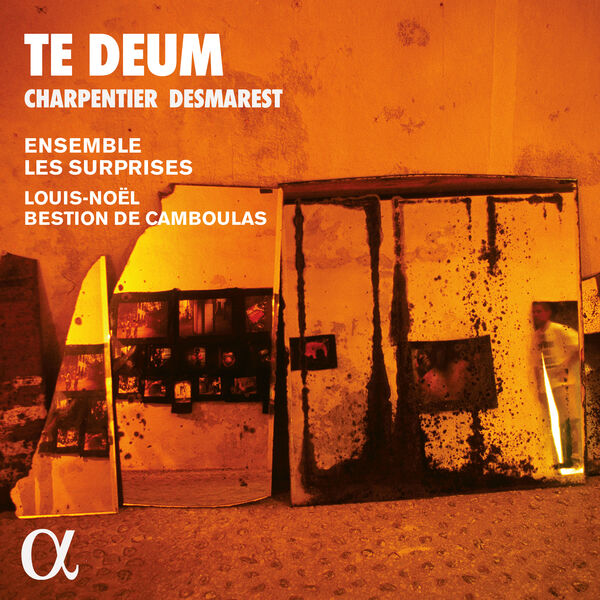
Te Deum Charpentier

Featured on: Charpentier & Desmarest: Te Deum (Ensemble Les Surprises)

I considered choosing a less obvious track from this album, but let’s be honest, there’s a reason why this is such an evergreen. That rambunctious opening drumroll followed by those cock-a-hoop trumpets—there aren’t enough words in my thesaurus to describe my exhilaration whenever I hear this.

Nevertheless, I can heartily recommend the rest of the album as well. This recording shines from all angles like a Versailles chandelier. And then there’s the way the singers, doubtlessly for historical accuracy, Frenchify the Latin. So the ‘u’ in ‘laudamus’ doesn’t sound like ‘boot’ but like—well—‘parvenu’ (pronounced in French). Which, for some reason, I find endlessly entertaining.

9. Funeral March for Rikard Nordraak (Edvard Grieg)

Funeral March Richard Nordraak Grieg

Featured on: Grieg: Symphonic Dances (Bergen Philharmonic Orchestra, Edward Gardner)

On to more drums and winds, but less jolliness. This funeral march was written by a young Edvard Grieg to honor his friend and mentor Richard Nordraak, the composer of the Norwegian national anthem who died aged 23 of tuberculosis.

As dictated by convention, this march is a mixture of pomposity, tenderness, and grief. Although you might also detect a pang of guilt. After all, Grieg had ignored his sick friend’s incessant pleadings for a visit out of fear of catching the disease himself.

Towards the end of his life, Grieg always kept a copy of this score in his briefcase, in case there was need for some impromptu serenading when he suddenly dropped dead. It was played at his funeral in the end. If you want it to accompany your own interment, this recording by the Bergen Philharmonic Orchestra will not disappoint.

8. Finale, Presto from Symphony nr. 98 (Joseph Haydn)

Haydn symphony 98

Featured on: Haydn 2032, Vol. 16: The Surprise (Il Giardino Armonico, Kammerorchester Basel, Giovanni Antonini)

I elaborately sang the praises of Haydn this year. So it makes sense to include some of his music in 2024’s overview. And the Haydn 2032 series is so good that I can include it in every year’s list.

This allegro is a perfect illustration of Haydn’s unique approach to composition. It starts with a lighthearted and, dare I say, forgettable melody. But then it branches out to all corners of the emotional spectrum.

The final surprise is a short but lively keyboard solo just when you thought the movement was grinding to a halt. At the premiere in London, this was played by the 60-year-old Haydn himself—never particularly known as a virtuoso. Imagine Bob Dylan suddenly turning into Billy Joel at the piano, and you’ll understand why the baffled crowd immediately demanded an encore.

7. A Ballet Through Mud (RZA)
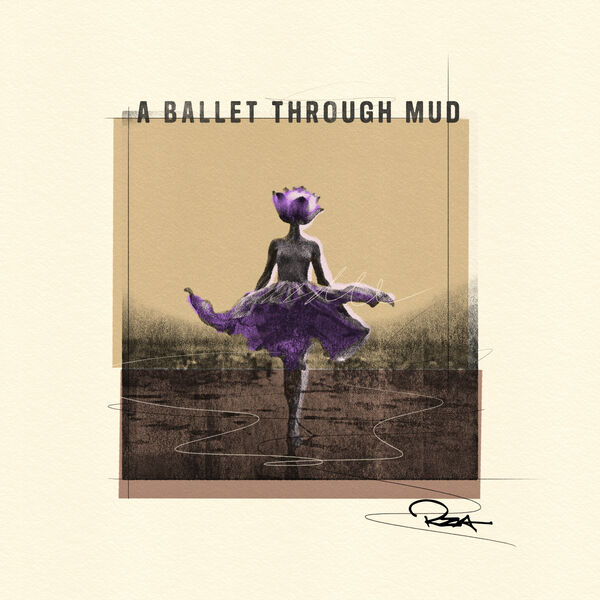
A ballet through mud

Featured on: A Ballet Through Mud (Colorado Symphony)

Speaking of surprises, when I first heard this track in the background, my first guess was Rimsky-Korsakov—mainly because of the obvious quotation from Scheherazade. Turned out the composer was RZA, aka Robert Fitzgerald Diggs, of Wu-Tang Clan fame.

RZA is quite the renaissance man: rapper, filmmaker, actor, composer, and producer. It’s the producer job that brings in the C.R.E.A.M, though. So it’s no surprise that this album, apart from some beautiful melodies, stands out for its amazing orchestration.

6. At the Purchaser’s Option (Rhiannon Giddens)

At the purchaser's option

Featured on: But Not My Soul: Price, Dvořák & Giddens (Ragazze Quartet)

Rarely is there such a heartbreaking story behind an innocuous title. Listen to Rhiannon Giddens tell it and stick around for her mesmerizing performance:

This original version gets its emotional punch from the combination of the laid-back banjo music with Giddens’ dignified and controlled anger.

The string quartet arrangement by Jacob Garchik is more extroverted, releasing all the pain and rage through plaintive countermelodies, plucking on snares, and hammering on wood. No substitute for the original, but certainly a worthy complement.

5. Tuba Mirum (Wolfgang Amadeus Mozart)

Tuba mirum mozart

Featured on: Mozart: Requiem (Pygmalion, Raphaël Pichon)

This one will be on a lot of lists this year. Raphaël Pichon interweaves Mozart’s Requiem with lesser-known compositions by the composer that seem to eerily foreshadow his final work. Certainly interesting, but it’s the amazing performance of the pièce de résistance that will turn this into a classic recording.

In the liner notes, Pichon explains how Mozart’s Requiem is in some ways an extension of his operas, “[elevating] the orchestra to the status of an additional character, [even] the most complex character to convey what could not be expressed in words.”

That’s nowhere more evident than in the Tuba Mirum, an almost operatic quartet with a trombone as the fifth character. But Pichon also brings out the dramatic power of Mozart’s (or is it Süssmayr’s?) string section as a sixth member of the conversation.

4. Strike the viol (Jakub Józef Orliński/Henry Purcell)
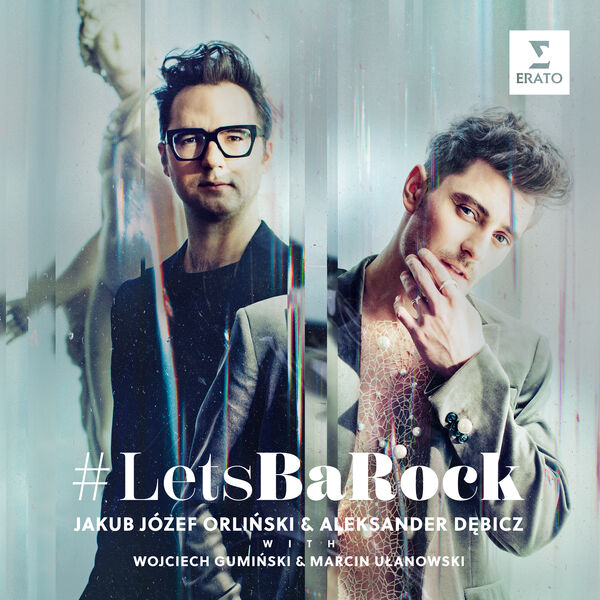
Strike the viol

Featured on: #LetsBaRock (Jakub Józef Orliński, Aleksander Debicz)

Let me get one thing off my chest first.

Dear classical music marketing people, I know pop-classical crossover is hard to sell. But let me assure you that album titles such as these only make things worse. It sounds like something that was coined in the seventies.
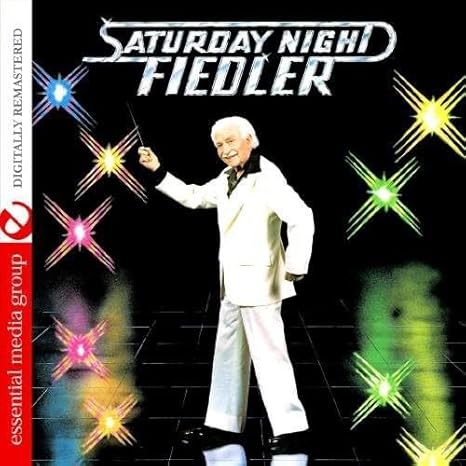
Saturday Night Fiedler
Good times, but not to be revived.

But wait a minute, I retract my words. I see you’ve added a contemporary touch: the completely meaningless hashtag! An unmistakable sign that you are truly ‘with it’.

Why should I care? Because this is a great album, and it would be a pity if the already tiny potential audience for this sort of thing was put off by this horrible title.

Countertenor Orliński and pianist Debicz bring cover versions of lesser-known baroque tunes and some of their own compositions in various 20th and 21st-century musical garments—ranging from jazz to hip-hop.

The combination of rich stylistic variety and consistent bare-boned instrumentation (mostly just voice, piano, drums, and bass) works extremely well. Just play this track, repress your purist prejudices (in either direction). And admit that it just, well, rocks.

3. Piano Quintet in G Minor: Largo (Sergey Taneyev)

Sergey Taneyev

Featured on: Taneyev: Violin Sonata in A Minor & Piano Quintet in G Minor, Op. 30 (Spectrum Concerts Berlin)

“Unfortunately for Sergei Taneyev, his music has long been held in high respect.” Nothing can be improved about that introduction by Gavin Dixon to this relatively unknown Russian composer. As a pupil of Tchaikovsky and teacher of Scriabin and Rachmaninov, Taneyev is a key figure in the history of Russian music. But he himself was more attracted to the Germanic tradition, earning him the nickname of ‘Russian Brahms’.
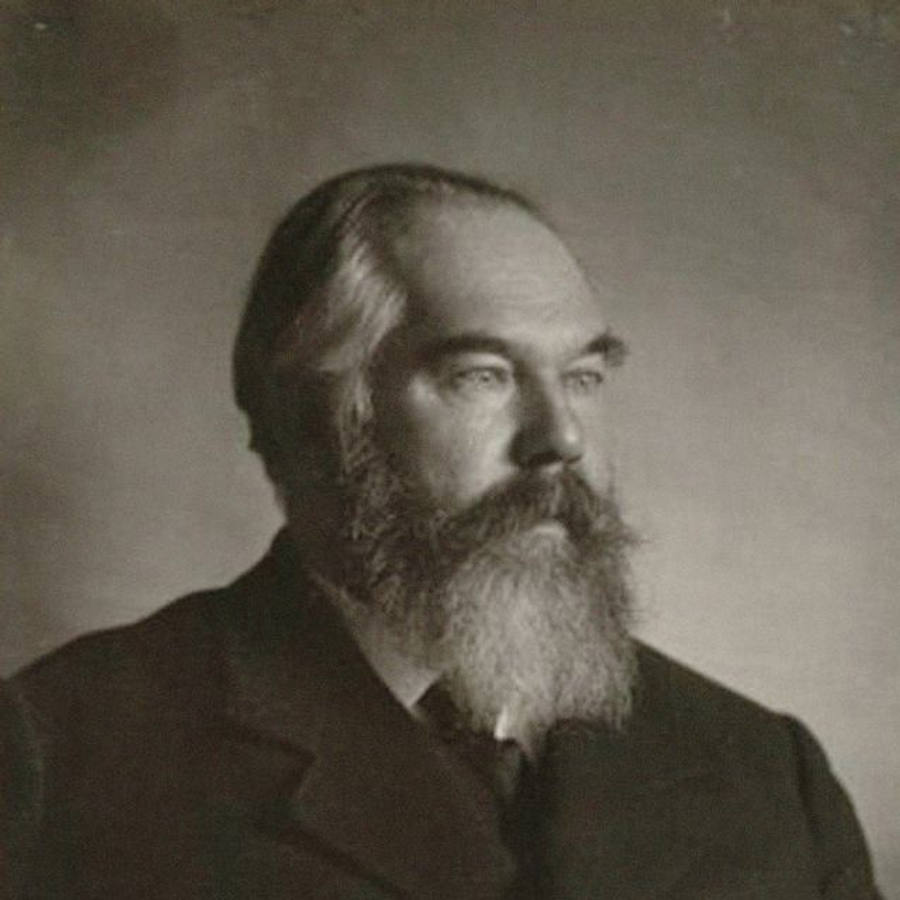
Much like Brahms, Taneyev combines strict compositional procedures with soaring expressions of emotion. This largo from his piano quintet is a nice example. It’s written in the respectable baroque form of a passacaglia, where one melody (presented very dramatically in unison at the beginning) is repeated throughout the movement. It’s a strong anchor for a deep dive into the innermost depths of the human soul—classical romanticism at its best.

This passionate aspect of Taneyev’s music seems to be overshadowed by his reputation as an academic traditionalist. His uneventful personal life might also have something to do with it. A lifelong bachelor, the closest he came to scandal was when Tolstoy’s wife took a shine to him. She wasn’t particularly subtle about it, which enraged Tolstoy. Nevertheless, the whole thing completely passed by Taneyev’s notice.

Maybe all that emotional torment in his music had no basis in real life. Or maybe his ‘lifelong friendship’ with Tchaikovsky was more complicated than most bios would have us believe. In that case, I hope someone discreetly informed poor Mrs. Tolstoy.

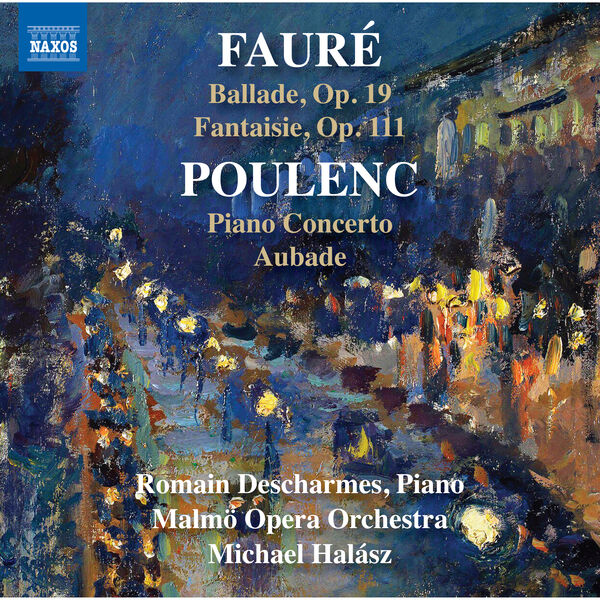
2. Piano Concerto in C-sharp Minor: Allegretto (Francis Poulenc)
Poulenc piano concerto

Featured on: Fauré & Poulenc: Works for Piano & Orchestra (Romain Descharmes, Malmö Opera Orchestra, Michael Halász)

“Half monk and half naughty boy.” Now that’s more like it. It’s how critic Claude Rostand described Francis Poulenc, a composer who’s often derided for not being sufficiently serious. Understandable, when you listen to this first movement of his piano concerto, where he even outdoes Haydn in his constant thwarting of our expectations.

Maybe it’s a bit much and the whole thing misses a sense of unity. But his gorgeous melodies are unsurpassed by anyone but Mozart or Schubert. I couldn’t get the main theme out of my head for at least a week.

And then there’s that solemn brass chorale around the 6-minute mark, dialoguing with the piano and strings. Poulenc lets the seductive main theme kick in again with scarcely any transition, bringing the monk and the naughty boy face to face and creating a moment of sublime beauty.

1. Violin Concerto, Op. 15: II and III (Benjamin Britten)

Violin concerto Benjamin Britten

Featured on: Britten: Violin Concerto, Chamber Works (Isabelle Faust, Symphonieorchester Des Bayerischen Rundfunks)

In 1939, Benjamin Britten arrived in the United States seeking refuge from the rise of fascism and militarism in Europe. His subsequently written violin concerto is therefore often regarded as a commentary on those troubled times.

Some say the young Britten went a little overboard with this concerto. The orchestra (especially the percussion section) is unusually large, and the violin part extremely demanding. It’s hard to imagine how some of the parts of the cadenza at the end of Part II can be played without at least one extra hand.

It’s impossible to separate these two movements: there’s no break between them and the theme of the passacaglia of Part III (a simple rising and then descending scale) is foreshadowed in Part II.

The general mood of Part II is one of terrible, beautiful violence (something that can only exist in art), reminiscent of Beethoven’s Ninth Symphony. There’s no triumph in Part III though, only resignation without acceptance.

It’s easy to imagine Britten writing this in 2024. But where would he escape to?
Messiaen’s Turangalîla-Symphonie: big, beautiful, and too long

A few months ago, I got furious at Gustav Mahler. In hindsight, the fault was mostly my own. I voluntarily attended a performance of his second symphony with no intermission, no legroom, and no way to escape.

To divert my mind from the double assault of leg cramps and sleep, I attempted to engage with the music. But each bland melody I tried to follow was quickly overtaken by other themes that were equally uninteresting. They could have been clever variations of each other, but honestly, who cares?

As the concert dragged on, I decided to focus on the percussion section and their amusing logistics of striking the proper noisy apparatus at the right time. But even that wore off after ten minutes.

When the full-scale choir started their pompous preaching about redemption and resurrection, I well and truly had enough.

Herr Mahler, I adore your fourth symphony, most of your sixth and parts of your fifth. But your continuous refusal to cut down your works to human proportions means you will always be no more than a ‘composer who has his moments’ to me.

Also, adding more exotic instruments to a symphony adds novelty value, not substance. The chance I will ever listen to your fabled ‘symphony of a thousand’ is no higher than 0.1 percent.

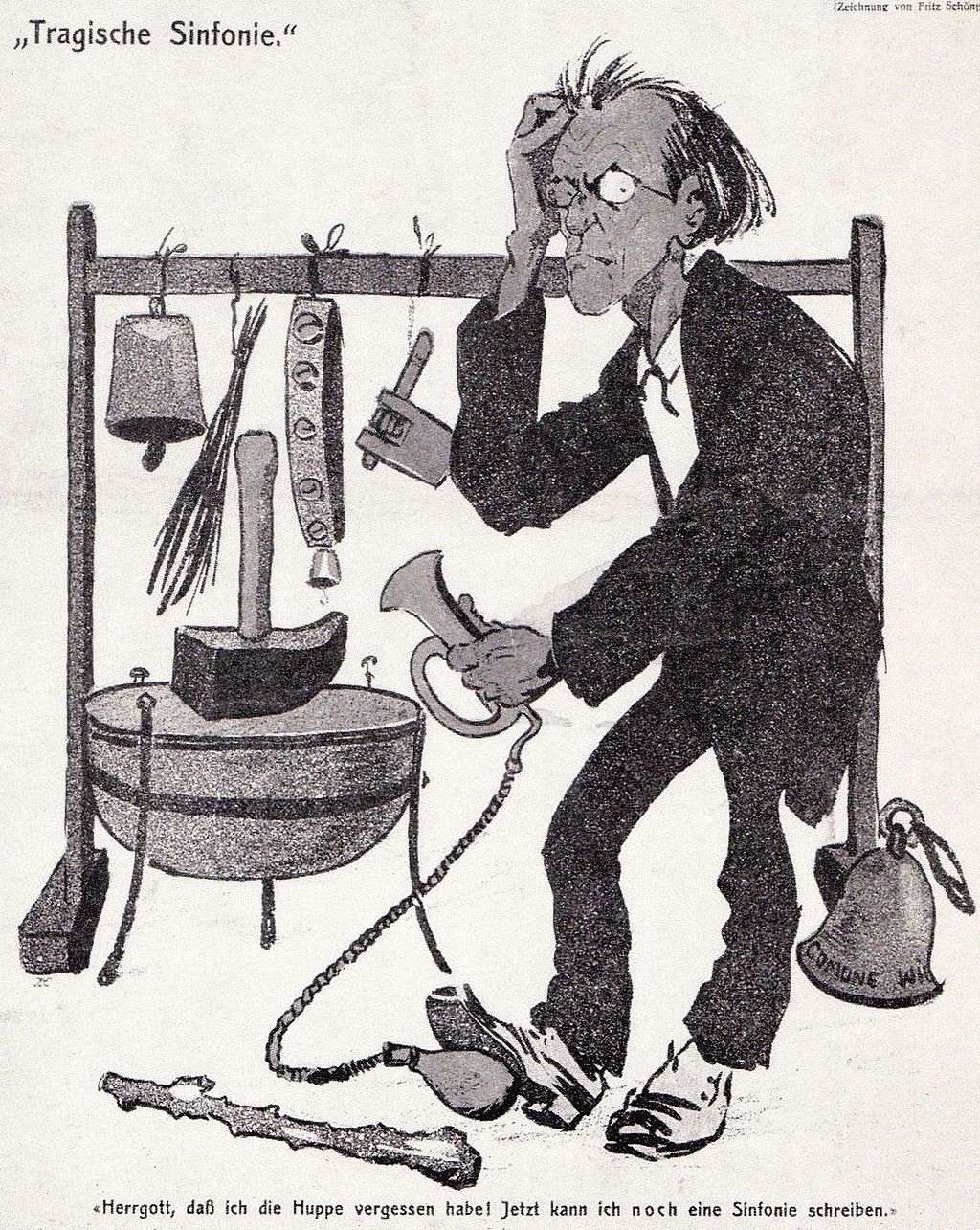
Mahler instruments
“Dear Lord, how could I forget the motor horn! Now I have to write another symphony.”

Finally, what also doesn’t alleviate my boredom or back pain while listening to your output is the philosophical guidebook that comes with it. Why burden your audience with your perennial woes about life and death? Just tell it to your shrink.

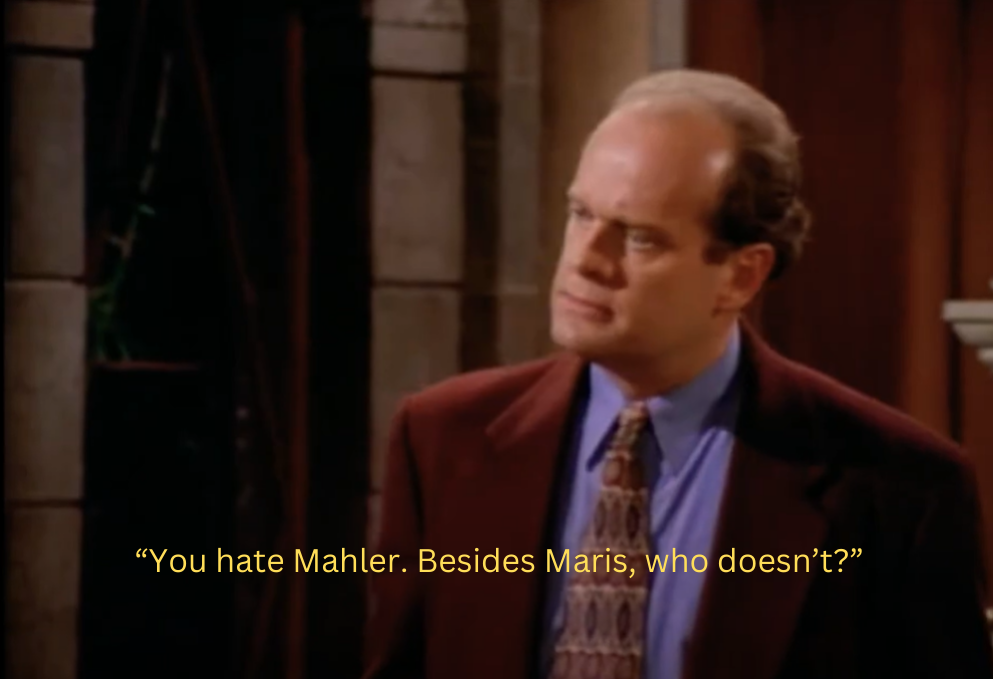
Frasier hates Mahler
Although probably not this one.

Classical music’s obsession with length and size

All right, maybe I just wasn’t in the mood that night. And perhaps I should have acquainted myself with the work before going to a concert.

Nevertheless, I can’t imagine I’m the only one with mixed feelings about these monstrous compositions that make up a big chunk of the classical repertoire – massive ideas that can only be expressed through colossal orchestras that go on endlessly.

That’s partly because our listening habits have changed over the last century. A live oversized symphonic orchestra must have made an overwhelming impression on ears unprepared for anything larger than a small ensemble.

We, on the other hand, are so accustomed to the most exotic of sounds directly entering our ear canals at all volumes and all times of the day that some wonder if we’re not already too deaf to enjoy non-amplified music properly.

Similarly, our on-the-go listening behavior doesn’t prepare us for concentrating on a piece of music for longer than five minutes, let alone for more than an hour.

However, we shouldn’t be too hard on our MTV/TikTok brains (depending on which generation you identify with). Consuming the ‘masterworks’ in easily digestible chunks was common throughout history. The idea that isolating a pretty adagio from an overall dull string quartet is as uncivilized as licking the frosting from a carrot cake is an invention as recent as the late 19th century.

Carrot cake
More recent, in fact, than the invention of carrot cake.

The unlimited musical resources behind Turangalîla

All this is to say that I hesitated to listen to Olivier Messiaen’s Turangalîla-Symphonie for a long time, despite its reputation as one of the 20th century’s musical masterpieces.

It was commissioned by conductor Serge Koussevitzky shortly after the Second World War. Koussevitzky explicitly said there were no limits on the length or the number of instruments.

Messiaen eagerly complied by writing a work of eighty minutes for an orchestra that includes – on top of the standard strings, woodwinds and brass – a percussion section of a vibraphone, glockenspiel, triangle, temple blocks, wood block, cymbals, tam-tam, tambourine, maracas, snare drum, tabor, bass drum, tubular bells and celesta.

The last empty corner of the stage is filled with a solo piano and an Ondes Martenot. This early electronic instrument makes the fweet sound like a radio dial going through different frequencies. That’s how Maurice Martenot came up with the idea during the war.

Incidentally, young Jonny Greenwood was a fan of the Turangalîla-Symphonie, which is why the Ondes Martenot pops up in many Radiohead songs.

A toy symphony for grown-ups

As expected, that big sound comes with big ideas. The Turangalîla-Symphonie is inspired by Tristan and Isolde and deals with romantic love and death – you can’t go much bigger than that. The name comes from two Sanskrit words:

  • Turaṅga means time that flows and refers to movement and rhythm.
  • Līlā means play of life and death, and of love.

All this – especially the Tristan and Isolde part – immediately brings the aforementioned 19th-century romanticism to mind.

But while Turangalîla displays the same level of excess, it holds back on the pomposity. This is an entirely different sound world from that of Wagner or Mahler. While the latter can display some ironic, even wry, humor, he’s never what you would call playful. And that’s precisely how I would describe Messiaen’s Turangalîla.

Because of the peculiar instrumentation and Messiaen’s tendency to mix styles, the work sounds like a toy symphony for grown-ups. You’re transported from dissonant passages over fevered, irregular dances to sweet Hollywood-esque chords. And everything’s pervaded by a light, jingly sound that informs you that nothing, not even excruciating beauty (and Turangalîla has that in spades), must ever be taken too seriously.

The man and the music

Maybe the composer’s personality has something to do with it. Olivier Messiaen (1908-1992) is portrayed by those who knew him as an almost comically good-natured man. Despite spending two years as a prisoner of war during the Second World War, he seems to have been free from existential torments.

A devout yet tolerant catholic and passionate ornithologist, he looked at the world with a mixture of old-man wisdom and child-like curiosity. This quote nicely sums up his outlook on life:

“I am convinced that joy exists, convinced that the invisible exists more than the visible, and that joy is beyond sorrow, and beauty is beyond horror.”
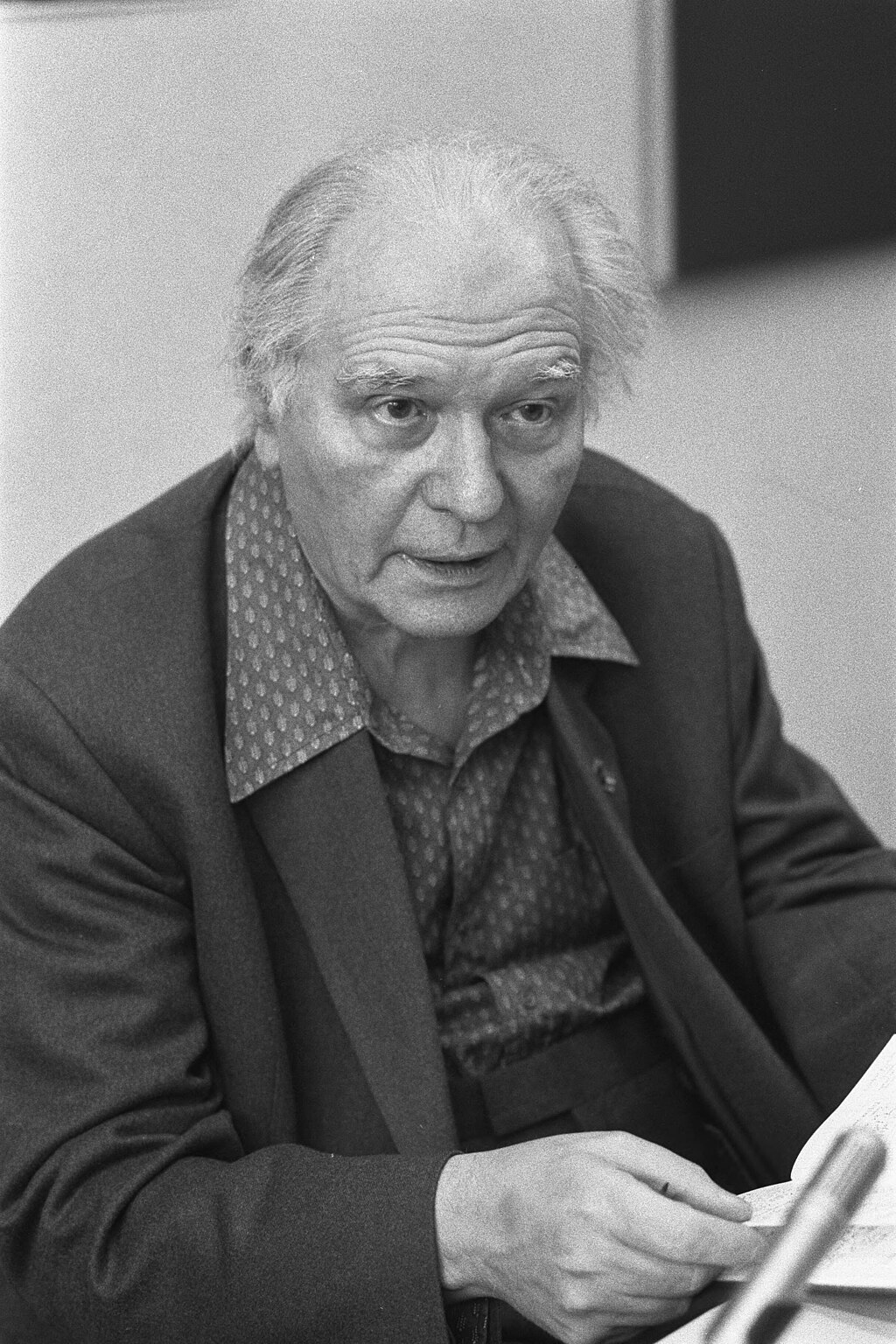
Olivier Messiaen, source

Messiaen Turangalîla

Although respectful of the man, avant-gardists such as Pierre Boulez despised Messiaen’s “sentimental” streak when it seeped into music – as it does profusely in Turangalîla.

That doesn’t mean Messiaen’s music is always easy on the ears. His melodies and harmonies touch familiar ground. But his rhythms are often very complex. Influenced by the tala structures of Indian classical music, he avoids regular meters. Instead, he likes to string together rhythmic cells of different lengths – which can be disorienting.

All in all, I would describe his music, in a musicological wholly unsound way, as frisky Stravinsky.

Two Turangalîla highlights to listen to

Turangalîla is an exuberant ode to life and love that I enjoyed more than I expected. Nevertheless, I couldn’t listen to it for more than 20 minutes. Not because it’s boring (mostly), but because it’s just too much. Too much noise, too many instruments, too many style changes. In short, at the risk of sounding like a complete oaf, too many notes – at least to be born for 80 consecutive minutes.

I therefore urge you to shamelessly lick some frosting from the carrot cake. Start with the two final movements, for example.

Turangalîla 3 is a set of variations that starts modestly with woodwinds and percussion. Gradually, the whole orchestra joins in, to which you can devote all your attention because the melody remains unchanged. Moreover, this happens to be a movement that uncharacteristically sticks to a regular 4/4 meter. It’s the perfect introduction to this remarkable sonic universe.

You’re then properly warmed up for the madness of Turangalîla’s Final, which starts like a drunken mariachi band and only further spins out of control. The rhythmic drive is characteristically irregular but also irresistible.

Around the fifth minute, you get a short moment to breathe, with extended treacly chords in the strings and the Ondes Martenot soaring high above it. Then, the whole thing climaxes with some more organized chaos and an extremely noisy final chord.

As you pick yourself up from the ground, you might agree that a little bit of Turangalîla goes a long way. But if you’re hungry for more, there’s another hour to set your teeth in. Bon appétit!

Are these the best classical tracks of 2023?

Probably not. But out of the ones I’ve heard, I’ve enjoyed these the most.

Listen to the Spotify playlist

10. Le tableau de l’opération de la taille (Marin Marais)

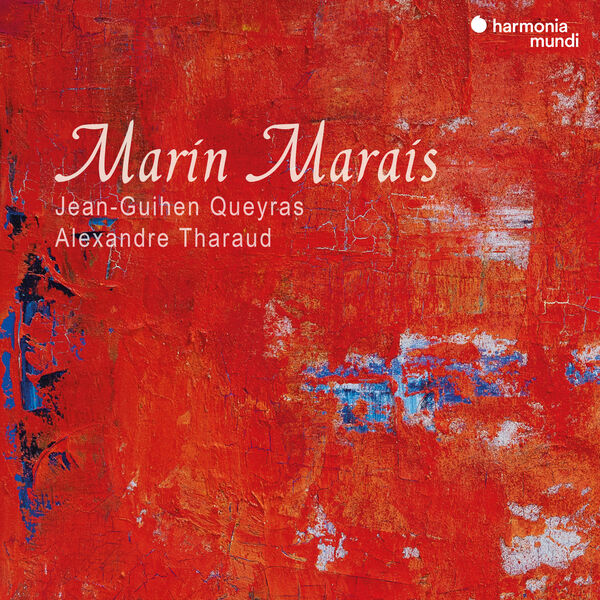
Marin Marais alb

Featured on: Marin Marais: Folies d’Espagne, La Rêveuse & other works (Jean-Guihen Queyras & Alexandre Tharaud)

Admittedly, this first entry is something of a ‘novelty song.’ It’s included on a record that has a lot more beauty to offer. Jean-Guihen Queyras & Alexandre Tharaud interpret viola da gamba pieces by Marin Marais (1656 – 1728) for cello and piano, with stunning results. You should check it out in full.

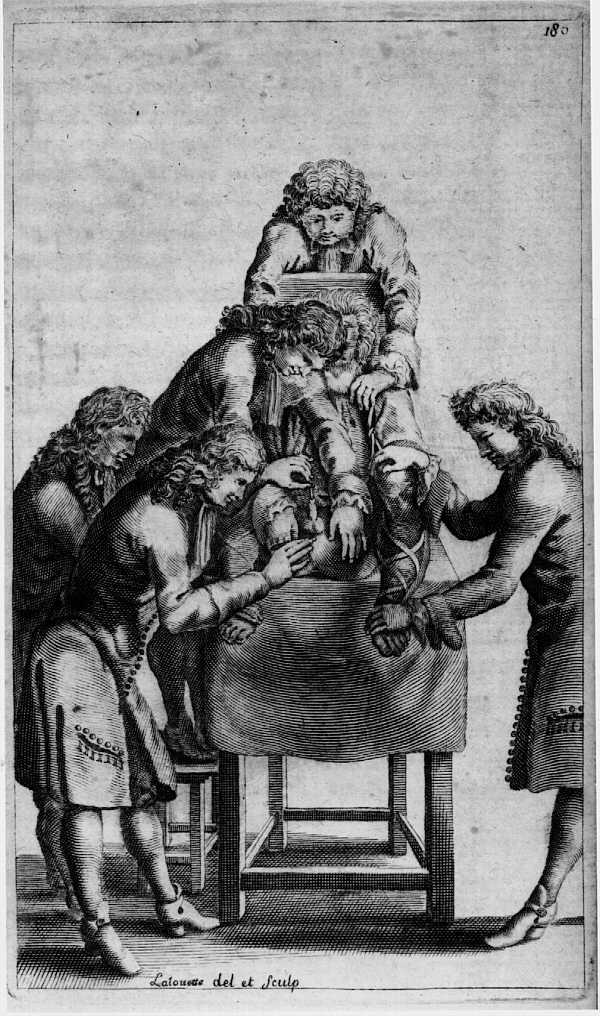
On this track, actor Guillaume Gallienne joins them to recite the text that Marais added to his piece Le tableau de l’opération de la taille. ‘La taille’ is the removal of a bladder stone, a horror Marais himself had to undergo when he was about 64.

Marin Marais opération de la taille
These people are smiling way too much.

Marais decided to pour his painful experience into a song. Much like Taylor Swift in Death by a Thousand Cuts, but with actual pain.

The text details the procedure. If you don’t understand French, consider yourself lucky. The music expresses the feelings of the patient. At the crucial/most excruciating moment, Marais decides the traditional Baroque style cannot capture the mood and skips ahead to early-twentieth-century expressionism. Who can blame him?

9. We played some open chords and rejoiced, for the earth had circled the sun yet another year (Dustin O’Halloran)

Echoes orchestra of the swan

Featured on: Echoes (Orchestra of the Swan)

Midlifers like me remember the concept of ‘mix tapes’: a carefully selected collection of songs that fit on a 60-or 90-minute cassette tape. The idea was that such a highly personal selection would reveal to the recipient, usually a love interest, how sophisticated we were – without the hassle of actually having to express a feeling or a thought. Unsurprisingly, that never worked. Not once.

Mix tape
Newsflash: Sophie erased your assortment of Morrissey and Nick Drake songs to make a ‘serious beats’ compilation for a guy named Chuck.

Orchestra of the Swan uses the mix tape concept to present a range of compositions that have no apparent reason to be on the same record: from Bach and Glass to Portishead and The Velvet Underground. If there’s an overarching message in all this, I couldn’t find it. It’s just a varied, enjoyable listen; sometimes, that’s all you want.

The track that stands out most is this minimalist piece, originally by the ambient duo A Winged Victory for the Sullen. The backbone of the composition consists, true to the title, of only a few open chords. They’re surrounded by flutters in the violins and some well-timed sighs of the cello.

Remove or add a few notes, and this would become the kind of music they generously disperse through your local wellness center. As it is, it sounds equally relaxing and moving. Halfway through, there’s a delightful Schubertian shift in the harmonies – always good for extra points in my book.

8. Fuga – allegro con spirito from piano sonata in e-flat minor, Op. 26, (Samuel Barber)

Barber piano sonata

Nobody could accuse Samuel Barber of taking the easy road when he started his piano sonata. It’s a composition that summarizes at least two centuries of keyboard music, with nods to Bach, Beethoven, Schoenberg and Gershwin.

It’s all the more impressive that the piece presents a unified whole where the seams never show. This final movement combines a classical fugue with jazzy inflections, twelve-tone rows and some Debussy-esque orientalism – ending with a humorous twist that would have pleased Papa Haydn.

Speaking of whom:

7. Adagio from Symphony nr. 31 (Joseph Haydn)

Haydn symphony 31

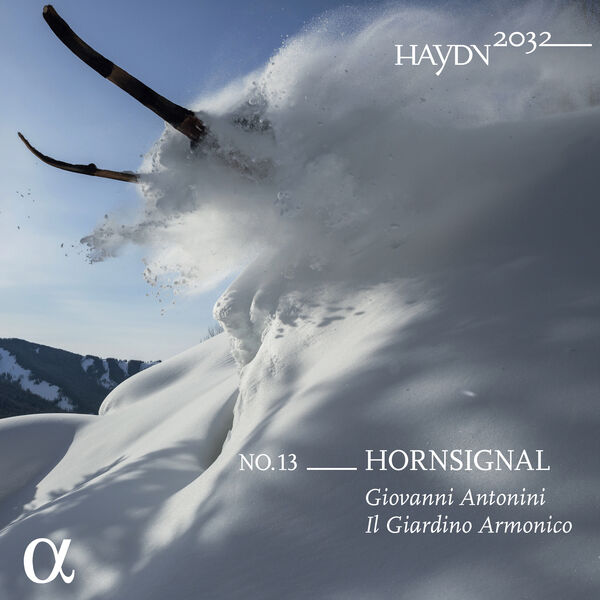
Featured on: Haydn 2032, Vol. 13: Horn Signal (Il Giardiono Armonico – Giovanni Antonini)

Giovanni Antonini and Il Giardino Armonico got it into their heads to record all 106 Haydn symphonies by 2032. Each – beautifully packaged – volume presents a few works under some common theme. On volume 13, it’s the presence of a prominent section of no less than four horns.

This early adagio in a gently rocking siciliano rhythm is far removed from the monumental ‘London symphonies’ of the older master. Haydn wasn’t yet speaking to the world but trying to please his master by catering to the strengths of the members of his ensemble. Each gets his turn to shine, with a special role for the horns, of course. But the young(ish) ‘master of form’ already knows how to unite it all into one balanced and engaging whole.

6. Tarentelle, pour flûte, clarinette et orchestre, op. 6 (Camille Saint-Saëns)

Bacchanale saint-saens

Featured on: Bacchanale: Saint-Saëns et la Méditerranée (Zahia Ziouani)

Camille Saint-Saëns visited Algeria no less than eighteen times. There, he picked up some tunes to include in several ‘oriental’ compositions.

These days, such compositional curiosity could lead to accusations of cultural appropriation. And you can’t deny that in those heydays of French colonialism, the musical exchange didn’t exactly happen on equal terms. So it’s nice that on this record, Zahia Ziouani combines the orientalism of Saint-Saens with contemporary Arabic songs.

The track I’ve chosen is an airy tarantella – Italian rather than oriental and with some Viennese flavors in the middle part. The flute and clarinet tumble acrobatically over each other, with other instruments sporadically joining in. It’s an impressive demonstration of Saint-Saëns’ compositional skill and keen talent for orchestration.

5. Solstice In/Solstice Out (Anna Meredith)

Nuc Anna Meredith

Featured on: Nuc (Ligeti Quartet – Anna Meredith)

Two tracks for the price of one, because they’re as indivisible as yin and yang. Solstice In drives up your blood pressure through a string quartet that moves from agitated glissandi to dull and obsessive pizzicati, combined with a piercing trumpet. Solstice Out brings you down again when both strings and trumpet are muffled and hesitant. It’s kind of like a musical hot-and-cold bath to both jolt and soothe your nerves.

4. Dans mon jardin à l’ombre (Anonymous)

Mon amant de saint-jean

Featured on: Mon amant de Saint-Jean (Stéphanie d’Oustrac – Le Poème Harmonique)

In 2023, I raved about an album by Joel Fredriksen that artfully combines Leonard Cohen’s songs with Renaissance chansons. One of those songs could have easily made this list. But I decided to include something from another album with a similar approach. It serves a fricassee of 17th-century popular songs, 17th-century Italian opera, and 20th-century popular songs – though never within the same tracks.

Thanks to a distinctive accordion and d’Oustrac’s impressive and theatrical delivery, this album sounds so French that it should come with a complimentary baguette. This track is a dark tale about a woman turning down a handsome young soldier because she’s married to a jealous, even violent older man. Musically, it would pair remarkably well with Cohen’s The Partisan.

3. Ah ch’infelice sempre (Antonio Vivaldi)

Sacroprofano

Featured on: Sacroprofano (Tim Mead – Arcangelo – Jonathan Cohen)

There are still those who look down on Vivaldi because he was ‘formulaic.’ They’re wrong for two reasons. First, every Baroque composer was formulaic by later standards. Yes, even J.S. Bach. Two, listen to an aria like this one and tell me with a straight face that this would be out of place in the St Matthew Passion.

The lyrics would have to be adapted, as this aria recounts the peculiarly frustrating sensation of being rejected by a nymph. Much like Cold As You by Taylor Swift, but with a minor divinity from antiquity instead of an emotionally unavailable dude from the Nillies.

Plucked strings express the falling tears in the A and A’ sections. The ending of the contrasting B section is lovely: one note hangs like an unfinished thought when the A’ section unexpectedly kicks in. It demonstrates that no formula is ever exhausted in the hands of a genius.

2. Ich will schweigen (Johann Hermann Schein)

Ein deutsches barockrequiem

Featured on: Ein Deutsches Barockrequiem (Vox Luminis – Lionel Meunier)

In 2023, the wealthiest man in the world conclusively revealed himself to be a narcissistic and delusional cartoon villain. As if that fact wasn’t scary enough, a surprising number of people are happy to condone his behavior because he’s a genius – just like Beethoven, J.S. Bach and Taylor Swift. ‘Genius’ is a label that we apply very quickly. I did it three sentences ago. And it’s not without its risks, like inflating the contribution of a few while underestimating those of the many.

Although Johann Hermann Schein is dutifully mentioned in all books on baroque music, no one would ever call him a genius.

Johann Hermann Schein
Although he had the hair of a genius. A MAD genius!

And yet, he composed what I consider to be one of the greatest masterpieces of the era. At least since I first heard it two years ago. It’s now recorded by my favorite baroque ensemble and, thus, an immediate certainty for this list. The text is a typical example of the long-lost virtue of humility, even slipping into the less commendable self-humiliation before the eyes of the Lord.

It ends with the sentence, ‘Ach wie gar nichts sind doch alle Menschen!’ – Oh, how all people are really nothing. Schein’s triumphant setting is paradoxical but fitting. Because what thought could be more liberating, both in the 17th century and today?

Elon Musk
Pictured: nothing

1. Maestoso from piano concerto nr. 1 in d minor (Johannes Brahms)

Brahms first piano concerto

Featured on: Brahms: Piano Concertos (Simon Trpčeski – Cristian Măcelaru – WDR Sinfonieorchester)

I earlier outed myself as middle-aged. Though that has been mathematically correct for quite some years, I’ve only truly felt it in 2023.

One of the great things about growing older is that you’re less likely to be taken on a rollercoaster by your emotions. But it unfortunately also means that music doesn’t ‘come in’ as powerfully as it used to.

Gone are the days when I could put on Beethoven’s Seventh or Schubert’s Unfinished at any time of the day and immediately enjoy the feeling of having access to all the sorrow and joy entangled with human existence. These days, I’m just as likely to mellow out to a Haydn adagio. Nice, but not quite the same.

But I’m also not that old yet. And I particularly feel that when I’m exploring the works of the young Johannes Brahms. His first piano concerto was finished shortly after the suicide of Robert Schumann – his friend, mentor, and husband of the love of his life. They say the opening chords picture that fateful leap into the Rhine. It doesn’t get much more adolescently pathetic than that. And I mean that in the best possible sense.

The concerto is not virtuosic but challenging to play, which is the exact opposite of what you would want as a soloist. The orchestration is also not particularly brilliant, as Brahms was still refining that part of his craft. Its first performances were not well received. Today, it’s respected, of course, but not nearly as popular as, say, Beethoven’s 3-4-5, Tsjaikovsky 1, or Rachmaninov 2.

None of that matters when you listen to this fantastic recording. The chemistry between the soloist and orchestra is out of this world, as is the sound quality. It never failed to entrance me, remind me what got me into classical music in the first place, and even make me feel twenty again!

And if you’ll now excuse me, I must get New Year’s dinner going. I won’t sleep a wink if I eat after 8 p.m.

Are these the best classical tracks of 2022?

Probably not. But out of the ones I’ve heard, I’ve enjoyed these the most.

Listen to the Spotify playlist

10. Qui ne regrettoit le gentil Févin, lamento à 4 (Jean Mouton)

The landscape of the polyphonists

Featured on: The landscape of the polyphonists (Huelgas Ensemble)

“He who did not mourn the gentle Févin, must surely be a rogue.” When renaissance folks honored their dead, they didn’t do it half-heartedly. Not in their texts, but also not in their music.

The gentle Févin was a colleague of Jean Mouton (1459-1522), who wrote this piece. It’s only 33 bars long in modern editions. Tenors and sopranos sing the exact same melody in canon. Basses and altos do the same with a complementary tune.

Paul Van Nevel and his Huelgas ensemble draw this out to three-and-a-half minutes by allowing the tenor and soprano to present the first part of the main melody by themselves and then bringing in the other voices. That gives you the chance to take in that beautiful line before getting engulfed by the full polyphonic jumble of notes – which can make listening to renaissance music such an ordeal.

The singers strike a tone which is fittingly plaintive without crossing into kitschy pathos. That drawn-out accent on the ‘Fé’ of the first ‘Févin’ alone was enough to land this track a spot on this list.

9. Yis’mechu (Benjamin Till)

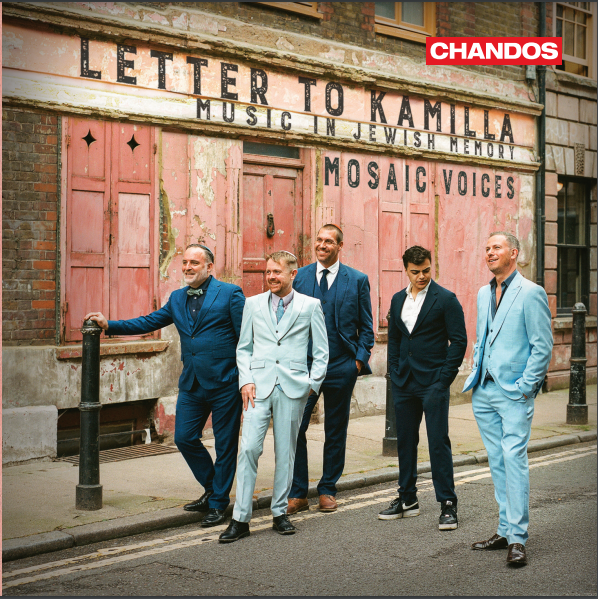
Letter to Kamilla

Featured on: Letter to Kamilla – music in Jewish memory (Mosaic Voices)

While we consider all Christian liturgical music a part of the Western classical tradition, Jewish music (often equally ‘Western’) is almost totally ignored. The kindest explanation is that Jewish music was often performed covertly and hardly ever written down. Still, there’s a lot left to be discovered and enjoyed.

Mosaic Voices is the ensemble that sings at London’s New West End Synagogue. Judging by their debut album, those services must be among the best shows in town. Apart from the basic melodies, there’s nothing ‘authentic’ about this music: the arrangements range from the typical ‘oom-pahs’ to close harmony, classical polyphonic techniques and hand-clapping. All very artfully done and with plenty of variety.

Yis’mechu is a celebration of the Sabbath, and the music fittingly bubbles with joy, even silliness – including some spicy modulations (like at 1:49). At the same time, there seems to be an undercurrent of sadness in this song, with sobs in the melodies and frictions in the harmonies. Hard to describe what exactly is going on, but it works.

8. Piano Quintet in F minor, Op. 34 – Scherzo. Allegro – Trio (Johannes Brahms)

Brahms quintets

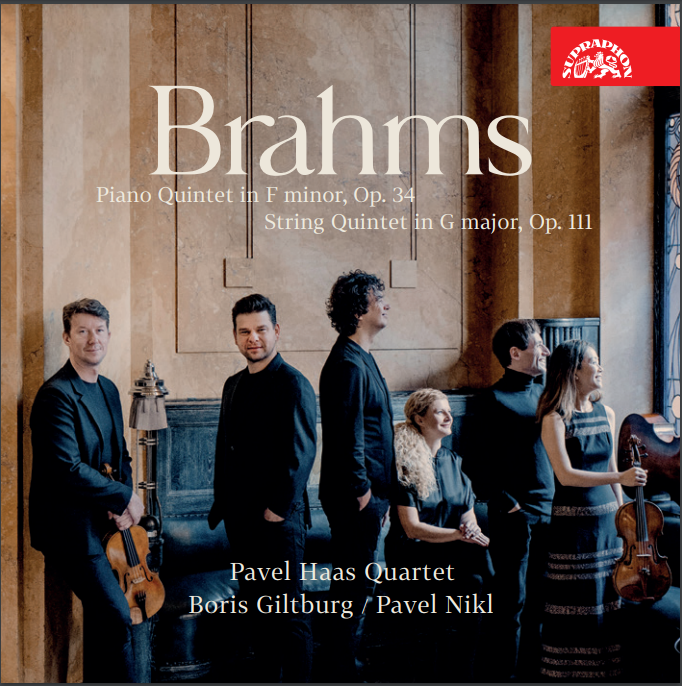
Featured on: Brahms: Quintets Opp. 34 & 111 (Pavel Haas Quartet, Boris Giltburg/Pavel Nikl)

Brahms is sometimes branded a conservative because he wanted to out-Beethoven Beethoven. But there’s no denying that precisely that ambition led him to compose – especially in his younger years – some of the most tempestuous music out there. This scherzo is as close to heavy metal as you can get without adding distortion and double bass drums.

The Pavel Haas quartet, supplemented with Boris Giltburg on piano, nail their performance with a vehemence and rhythmical precision that is out of this world. Strictly speaking, this is chamber music. But it’s pointless to imagine it in any other room than a concert hall. And impossible to listen to at home without cranking the volume all the way up to eleven.

7. Concert champêtre for harpsichord & orchestra, FP 49 – Andante (Francis Poulenc)

Concert Champêtre

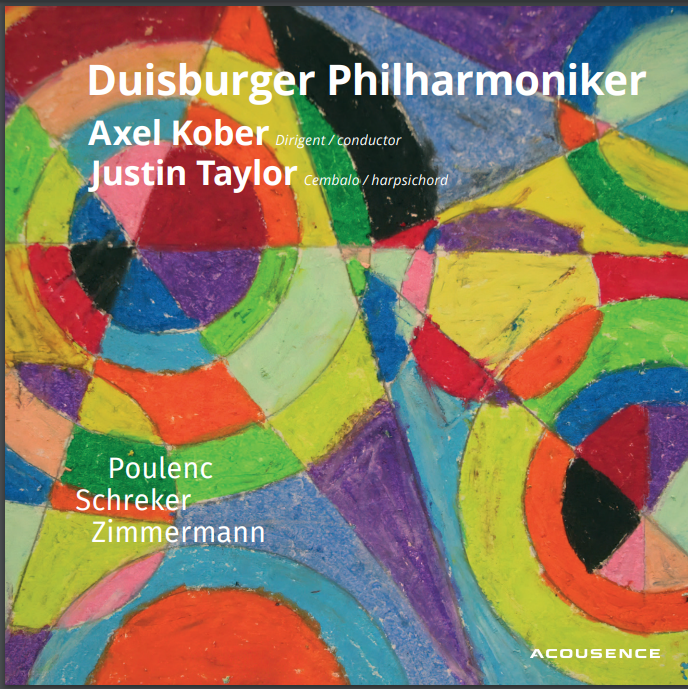
Featured on: Poulenc, Schreker & Zimmermann: Orchestral works (Justin Taylor – Duisburg Philharmonic Orchestra – Axel Kober)

According to the booklet that accompanies this wonderful recording, Francis Poulenc (1899-1963) styled his ‘pastoral concerto’ after baroque composers such as Couperin and Rameau. But my feeling is that he was mainly channeling one of his other musical heroes: Mozart.

This movement, in a gently rocking siciliana rhythm (just as Mozart used in his KV 488 concerto), is as much about the rich wind section as the solo instrument. In fact, when the harpsichord first enters, it is to give a sort of accompaniment to the melody that just preceded it – as if it’s late for the party.

The whole piece is a grandiose display of Poulenc’s greatest talent: melodic invention. One charming tune flows into the next. Sometimes it seems you are listening to Mozart, until a peculiar detail or bold turn reminds you that this is 20th-century music. Indeed, some of the best music that the 20th century had to offer.

6. Variation from violin sonata V in e minor, C. 142 (Heinrich Ignaz Franz Biber)

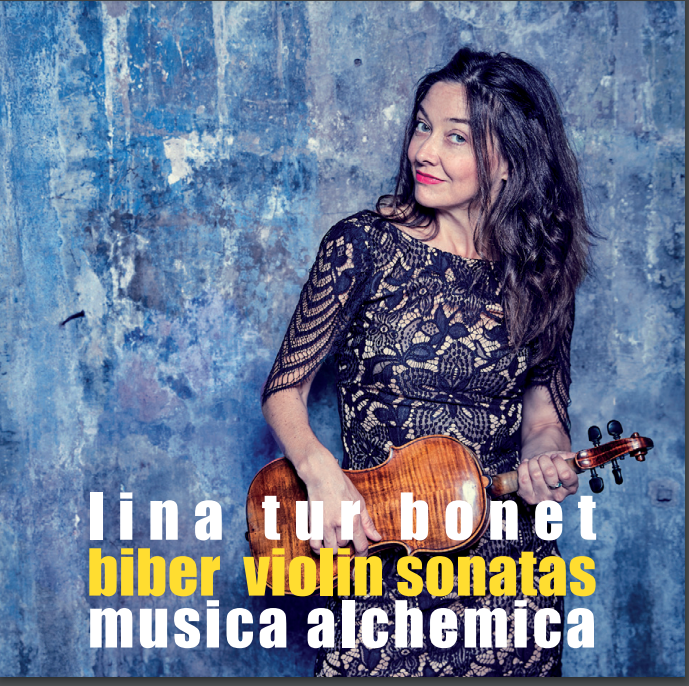
Biber violin sonatas

Featured on: Biber violin sonatas (Lina Tur Bonet – Musica Alchemica)

Isn’t it high time for another revival of baroque music? Only this time, let’s not make it about historical authenticity, but about doing whatever you want. Because that’s the freedom that baroque composers gave us. On paper, the beginning of this Biber variation looks like this:

Variation from violin sonata V in e minor

Only the solo violin is written out in detail. The notes below are the bass notes of the accompaniment that can be worked out freely. Put a cello and a harpsichord or organ there, and you get the typical sound of many a baroque album that’s excellently suited to not distract you during dinner parties. Put it in the hands of a varied ensemble (including theorbo, harp and lute) of inventive musicians and you’re up for an engrossing listening experience that demonstrates the genius of Salzburg’s second-greatest composer.

5. Imperial march (John Williams)

Imperial march John Williams

Featured on: John Williams: The Berlin Concert (Berliner Philharmoniker – John Williams)

Apparently, Vladimir Putin is a fan of Tchaikovsky. (Who wants to be the one to tell him?) But I think there’s a good chance that he’s strutting in front of the Kremlin mirrors to this John Williams tune every night. Because pure evil never sounded so cool.

Check out the album review

4. The hazelnut tree (Gabriel Kahane)

The hazelnut tree

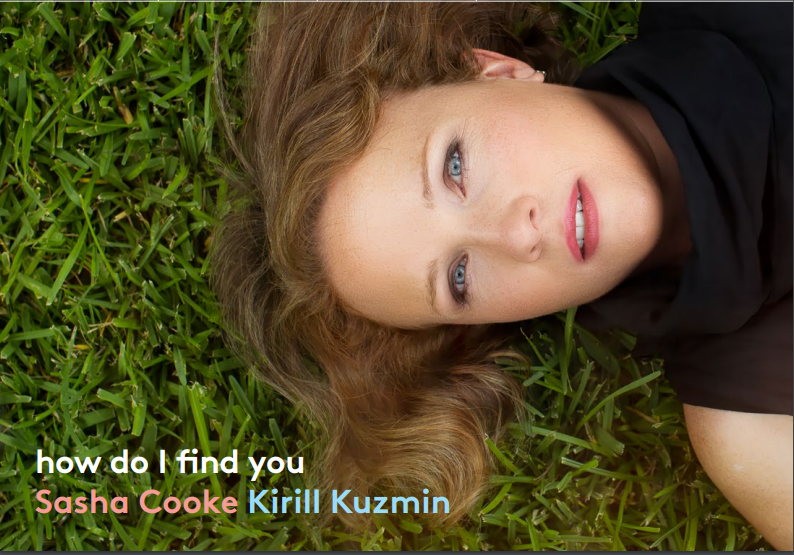
Featured on: How do I find you (Sasha Cooke – Kirill Kuzmin)

Like so many of us, mezzo-soprano Sasha Cooke was cooped up inside because of the corona virus in 2020. She decided to ask a bunch of composers to send her songs inspired by their experience during that period. That resulted in the album ‘How do I find you’, a nice sampling from what you could call the ‘indie classical’ scene.

The hazelnut tree was the song that I immediately liked most. The lyrics hint to the desire – very common during that period – to disengage from the “fresh threats of doom” that are filling the papers. The music ripples nostalgically, with a piano that steadily moves the flow along while subtly commenting on the lyrics – the hallmark of good song writing since Schubert.

I admit that I never heard of Gabriel Kahane before this song. Apparently he’s also a singer-songwriter cut from the same high-quality fabric as Sufjan Stevens and Rufus Wainwright. He performs this song himself on his 2022 album Magnificent bird.

3. Ka Bohaleng/On the sharp side (Abel Selaocoe)

Ka Bohaleng/On the sharp side

Featured on: Where is home/Hae ke kae (Abel Selacoe)

Remember how baroque music allows you to do whatever you like? Well, Abel Selacoe takes this opportunity to couple a theorbo and a kora to add improvisational accompaniment to a Platti cello sonata. He also hums along with Bach’s cello sarabandes. If you adhere to delusional concepts such as historical authenticity or cultural appropriation, please go to the next item on this list.

Ka bohaleng/On the sharp side would not be out of place on a pop album – another cultural divide Selacoe bridges effortlessly. The song is dedicated to mothers everywhere. Its text is based on the Sesotho saying that a woman holds a knife on the sharp side. Meaning: never underestimate her powers.

The music is a wild orgy of different influences: a typically African web of constantly shifting rhythms, meters, accents and tempi, paired with Western classical harmonies in the strings. Presiding the whole thing with his cello and amazing voice, Selacoe keeps everything on the rails towards a delirious climax that makes you go straight to the repeat button.

2. Fantasia in F minor for a mechanical organ, K.608 (arr. for 2 pianos by Feruccio Busoni) (Wolfgang Amadeus Mozart)

Fantasia in F minor for a mechanical organ, K.608

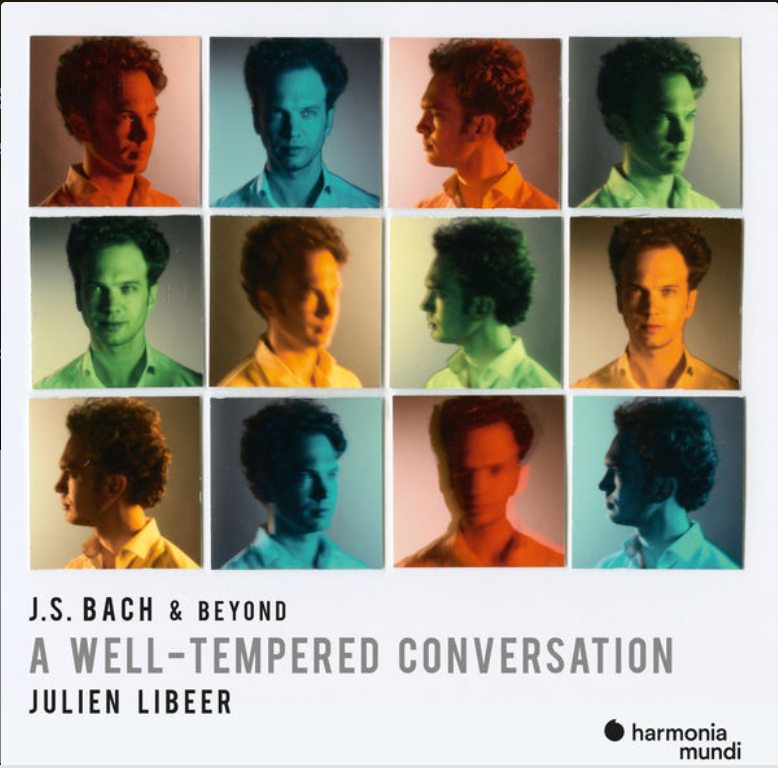
Featured on: J.S. Bach & Beyond: A well-Tempered conversation (Julien Libeer – Adam Laloum)

The self-playing mechanical organ was something of a marvel in the late 18th century. When Mozart was asked to write music for it, he no doubt reacted like the professional freelancer he was, “welcoming the challenge”. In truth, as he wrote to his wife, the commission bored him to death. And yet, the end result is one of his last great masterpieces.

Julien Libeer chooses this work as the halfway point of his journey through the history of keyboard music since J.S. Bach. A great choice, because Mozart’s fantasia looks back as well as forward. An opening in baroque French overture style flows into a Bach-like fugue and then an adagio overflowing with Mozartian charm. A slightly more complex and faster recapitulation of the fugue leads to the climactic ending.

At the same time, like a lot of late Mozart, the music looks forward to early romanticism, particularly – especially in this arrangement – to Schubert’s four-hand fantasia in the same key.

1. Ciacona seconda (Francesco Tristano Schlimé)

Ciacona seconda

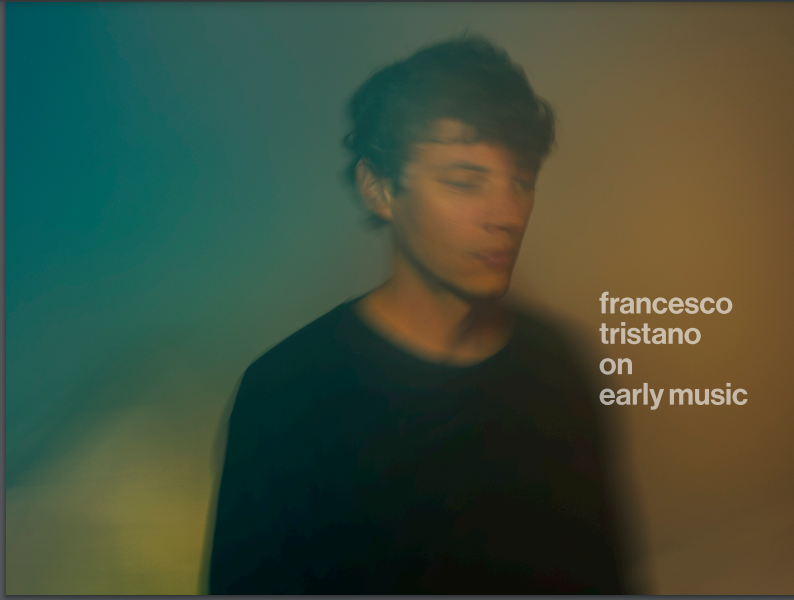
Featured on: On early music (Francesco Tristano Schlimé)

Of course, the history of keyboard music does not start with Bach. For his record On early music, pianist and composer Francesco Tristano focuses on 16/17th century pioneers such as John Bull, Orlando Gibbons and Girolamo Frescobaldi.

Tristano alternates faithful renditions of these renaissance/baroque pieces with his own compositions that are inspired by both the general style and particular details of the early music that surrounds them. Ciacona seconda is a chaconne based on an inconspicuous fragment lifted from a Frescobaldi piece that’s looped into infinity.

Like others on this lists, this is a composition that telescopes various styles and periods of music: from early baroque to jazz and minimalism. The end result is a hypnotic display of virtuosity that grabs you from its very first notes and never lets go.

Rebecca Clarke’s viola sonata: an unknown masterpiece (at least to me, and maybe also to you)

Women wrote music. All through history. That shouldn’t be news to you. ‘Woke’ scholars and performers talk and tweet about nothing else. Soon it will be outlawed to listen to Beethoven!

Or so the story goes. In the real world, several Beethoven symphony cycles were released this year alone. The classical music business is, after all, a business. So a lot of people must still be listening to those destinies knocking on doors and joys being oded.

It’s true that you’re a little more likely to come across recordings of works by women composers these days. Rest assured that you’re under no obligation to listen to them. But be aware that you’re severely depriving yourself if you don’t.

Rebecca Clarke Viola Sonata

Rebecca Clarke: composer without conviction?

The life of Rebecca Clarke (1886-1979) reads like a textbook case study of what women with musical, and particularly compositional talent, had to endure.

One revealing anecdote will do. When Clarke – mainly known as a violist – organized a concert in 1918 that included 3 of her own works, she thought that would appear a bit arrogant. So she decided to attribute one of the works – Morpheus – to the wholly made-up Anthony Trent.

Can you guess what happened next? Spot on: the critics agreed that Clarke was alright, for a girl. But this Trent chap was definitely going places!

And it seems that Clarke was already not brimming with self-confidence. This article gives an intriguing insight into her personality. Abused by her father during her childhood, she would suffer her whole life from a sort of imposter syndrome when it came to her creative endeavors.

Rebecca Clarke composer
Rebecca Clarke in 1919, the year she wrote her viola sonata.

It’s no surprise that Clarke almost exclusively stuck to genres that were considered suitable for women: songs and short chamber music pieces. There are only two exceptions: her viola sonata from 1919 and her piano trio from 1921. Tellingly, she wrote both for composition contests where her name, and gender, would be hidden.

Unless that narrative fits a bit too snugly in the poor-oppressed-woman-composer mold. That’s at least what Christopher Johnson thinks. And as Clarke’s, a great-nephew-by-marriage, owner of her rights, and someone who spent a considerable amount of time with her during her final years, his opinion certainly matters – even if it’s not definitive.

You can find Johnson’s sharply formulated views, along with a wealth of other resources, on www.rebeccaclarkecomposer.com. The other side of the biographical debate is represented by the Rebecca Clarke Society at www.rebeccaclarke.org.

And now, on to the music.

First movement

I don’t mean to belittle the songs and character pieces that make up the bulk of Clarke’s oeuvre. But a work like the viola sonata reveals that she was capable of much more. In the span of three movements, she brings an engaging story in a highly personal language – a unique blend of the musical influences that surrounded her.

The beginning of Clarke’s viola sonata sparkles with confidence. Over a sustained chord on the piano, the viola takes off forte and impetuoso with a clarion call of a melody that sounds almost improvised, but will turn out to contain the musical material for the entire movement – and beyond.

The hotheaded self-confidence of the first few notes soon begins to wane, like a balloon that rapidly deflates. The melody sinks to the lower register of the viola and settles on a gently rolling pastoral motif. Then the tension rises again, the piano joins in, and the first movement really takes off.

In the rest of the movement, those two moods – restless and pastoral – will battle it out. And eventually reach some sort of compromise. It’s especially when she’s tapping in to that second vein that Clarke’s music becomes extremely touching and original. The style is influenced by contemporary French music. Some of the judges thought the mystery composer was Ravel. But while that style can often be overly sweet and lofty (at least to my taste), Clarke fuses it with a healthy dose of English folk music which gives it warmth, and sometimes a dark edge. It’s also perfectly suited to the lower register of the viola, which features prominently in these fragments. In fact, you might consider the whole sonata as an exploration of the emotional registers of this ‘in-between’ instrument.

Second and third movement

The second movement, a scherzo in everything but its name, is all about impetuousness again. It’s a stunningly virtuosic piece – a sort of catalog of what you can do with, or to, a viola. The music takes a lot of sharp corners, in contrast to what comes next …

The beginning of the third movement is a simple unharmonized piano melody in pastoral spheres again. Beautiful minutes follow of gentle melancholy, until the viola settles on a dark murmur and the piano turns back to the motifs that opened the first movement. The finale is again a battle of the two moods, until they reach a new, but by no means final, conclusion.

Neglected and unwritten masterpieces

Rebecca Clarke’s viola sonata made it to second place in the contest. It never became as popular as it clearly should be. Although it did gain a place in the repertoire, especially after there was renewed interest in Clarke’s music in the 1970s as a result of second-wave feminism.

By then, Clarke was in her nineties and had given up composition long ago. Outliving her critics, who doubtlessly went to their graves wondering why Anthony Trent never lived up to his promise.

Album review: Folk Songs by Ficino Ensemble & Michelle O’Rourke

For centuries, there were basically two types of music in Europe: (what we now call) classical and folk. And although they differed in almost every possible respect, they gladly invaded each other’s territories.

For classical composers, there were many reasons to borrow from, or imitate folk music. Often to express some meaning attached to the folk style. Like the noble simplicity/boorish stupidity of the lower classes, the raw magnificence of nature, or the glorious soul of the nation. Sometimes just because they liked the tunes.

The last seems to be true for Luciano Berio, who wrote his Folk Songs cycle in 1964. It contains 11 songs from different traditions. Some are not ‘real’ folk tunes at all, but composed by other composers, including Berio himself.

Though leaving the melodies intact, Berio – known as a ‘difficult’ composer – combined them with more adventurous accompaniments. On the album Folk Songs, the Ficino Ensemble gives the front stage to the voice of Michelle O’Rourke and relegates itself to a supporting role. A wise decision, because O’Rourke’s voice – classically trained but with clear folk sensibilities – magnificently brings out the beauty of these ‘simple’ melodies.

Folk Songs Ficino Ensemble

Medieval saints and barnyard animals

While Berio’s folk songs are always a pleasure to listen to, I doubt Ficino Ensemble’s interpretation is an indispensable addition to an already extensive discography. What I really like about this album are the four new compositions that are inspired by the folk style.

The works by Kevin O’Connell and Garrett Sholdice are more avant garde than Berio’s. They deconstruct the folk idiom and rearrange the barely recognize elements on a blank canvas. Doubtlessly interesting, but not really my cup of nettle tea.

The two remaining works tap into another vein: the British pop/rock folk sound that’s been with us since the seventies – with its mystical, faux-medieval atmosphere. Cronachdain Suil by Kate Moore is based on traditional and folkloric spells evoking Saint Brigid and Saint Mary for protection in times of danger. It’s a brooding piece underpinned with a steady pulse but constantly shifting meters. At the end, its settles upon a 7/8 groove and climaxes in pagan ecstasy. They made a video that nicely captures the atmosphere and contains some barnyard animals silently judging you.

Cronachdain Suil Kate Moore
She knows why you took so long in the shower this morning.

But for me, the high point of this album is its opening track: Judd Greenstein’s Green Fields of Amerikay. The lyrics talk about making the journey from Ireland to the United States. Around it, Ficino Ensemble weaves a tapestry of waves and flurries. After a quasi-improvisational start, the music gradually finds speed and direction until the journey ends in an eerie ‘farewell’. An impressive salute to a time when the US was still the promised land.

Inspector Morse: classical music’s uncommon ambassador

In my previous blog, I talked about how classical music was the model for many amazing film scores. But when classical music is itself the subject of tv or cinema, it’s often in a negative light. To indicate that a character is old-fashioned, stuffy, and possibly a psychopath.

Classical music fan
A typical fan of Bach’s Goldberg Variations

In short: the classical music lover on the small or big screen is seldomly someone with whom you’re supposed to sympathize. With one curious exception: Endeavour Morse.

Amiable snob

To be clear, inspector Morse is not a likeable guy – at least not in a traditional way. This late version of the British gentleman detective is from a humble background. But that doesn’t stop him from looking down on just about everyone around him. He’s exceptionally mean to his faithful subordinate, Sergeant Lewis, whom he scolds for his grammar, his lack of cultural capital, and occasionally even his wife.

Music inspector Morse
Chief Inspector Morse, looking down on you and everyone else.

Nevertheless, you can’t help rooting for the old grouch. Because of his sarcastic sense of humor and anti-establishment stance. And because he’s a dog that barks but never bites. There are even some surprisingly tender moments between him and Lewis.

Conservative taste

Through his refined tastes, Morse tries to distance himself from his unhappy childhood. He sculpted himself a persona out of poetry, museum visits, craft beers (long before those became fashionable) and – of course – classical music.

It’s no wonder that his preferences are on the conservative side. Lots of Mozart and Wagner. Scarcely something composed after 1900. The only time he stumbles into other musical worlds, he’s genuinely bewildered – like in the episode Cherubim & Seraphim, which is against the deafening backdrop of the rave scene. Hearing a familiar sample in one of the dance tracks, he shouts indignantly: “But that’s Allegri’s Miserere, conducted by Sir Adrian Boult!” – as if he’s made a crucial discovery in his investigation into the death of a young schoolgirl.

Spoiler alert!

Two episodes are inspired by a piece of classical music. In Masonic Mysteries, Morse is persecuted by a nemesis who taunts him with references to Mozart’s Magic Flute. But my favorite is Twilight of The Gods, where Morse investigates the shooting of a Welsh opera singer who’s famous for performing Brünnhilde in Wagner’s ring cycle.

The episode is littered with references to the famous opera tetralogy, including a subplot where it appears that the villain of the story murdered his son – just like Wotan killed Siegmund. There are also a lot of helicopters flying around, for no other reason I can think of but as a nod to the helicopter scene in Apocalypse Now, set to the Ride of the Valkyries. There’s even a burning Walhalla at the end, even if it’s a scale model.

Reluctant popularizer

Naturally, the success of the Inspector Morse series led to a stream of soundtrack CDs that sold like hot cakes. One wonders what the character himself would have thought about these ‘greatest hits’ CD boxes for sale at supermarket checkouts. I imagine a conversation such as this one:

  • Morse: “Lewis, but this is the sort of music l like, only cut up into less-than-four-minute fragments. Look, that’s the immolation scene from Götterdämmerung, conducted by Furtwängler!”
  • Lewis: “Ay Sir, it’s from a television series me wife likes!”
  • Morse: “Well, she would, wouldn’t she? As Frank Lloyd Wright said, Lewis, television is chewing gum for the eyes.”

Nevertheless, it’s possible that Inspector Morse did more for the popularity of classical music than many well-meaning but predictably failing educational initiative.

For decades, classical music tried to get rid of its reputation of pretentiousness in order to appeal to the masses. And when the masses do fall for it, it’s because the greatest snob of all listens to it in his vintage Jaguar Mark 2. Go figure.

Inspector Morse theme music

Finally, you can’t write about Inspector Morse and music without mentioning one of the most lasting legacies of the series: the theme music by Barrington Pheloung. It cleverly starts with the violins rhythmically spelling out MORSE in, well, morse code.

It’s still the most popular TV soundtrack ever written – leaving behind works by Khachaturian, Rossini and Prokofiev. Something that the inspector himself would certainly have frowned upon.

Review: John Williams – The Berlin Concert

There’s no shortage of cultural pessimists who complain about the dwindling societal status of classical music. Until the middle of the twentieth century, they say, classical music was part of popular culture. Today, it’s nothing more than a shrinking niche.

That might be true if you look at record sales and concert attendance. But dig deeper, and you notice how the classical music tradition influenced much of the culture that supposedly supplanted it. And the best example is the Hollywood blockbuster.

Wagner in space

What part of the success of movies like ET, Jurassic Park or Harry Potter would be due to their music? My guess is 60 percent. Up to 80 percent for the Star Wars movies. If they didn’t have the best soundtrack of all time, their attraction would be inexplicable.

Yoda Star Wars music
“Pseudo-profound Muppet, I am.”

The man responsible for the music in all those films is John Williams, a composer who brought the sound of late-romantic composers such as Wagner and early modernists such as Stravinsky and Holst to just about every cinema theatre and living room. And who – at ninety years of age – is now embraced by the classical music establishment. Both the Vienna and Berlin Philharmonic welcomed him for a concert and album devoted to his work. You can’t get more canonized than that.

John Williams Beethoven
John Williams (on the right). Beethoven (on the wall).

Goosebumps

If you needed one, listening to the recording of The Berlin Concert is a reminder that Williams wrote some of the most exciting music since World War II. And I mean that in an almost physical way. Doubtlessly nostalgia plays a part in it, but I get goosebumps every time I hear the Flying Theme from ET or the Throne Room & Finale music from Star Wars. The Berlin Philharmonic devotes all of its considerable forces to this project. The result is both a breathtaking musical experience and an opportunity to brush up on your knowledge of all the instruments in a symphonic orchestra. Not in the least the percussion and brass sections.

Winning formula

There’s one thing that Williams does better than anyone else: conveying immensity in music. Immensity of emotion, like in the heartbreaking music from Schindler’s List, which is inexplicably not included on this album. Or immensity of space, like in the theme from Jurassic Park, which immediately conjures up rolling planes with grazing brontosauruses – or whatever they are (ask your local six-year-old).

His themes often combine a strong rhythmic drive (hence the percussionists working overtime) and yearning melodies that quickly reach their climax – then start over again.

That’s it, that’s the formula. Oh, and trumpets. Lots of trumpets. Williams even asked for American trumpets to be used in this Berlin concert. Because they make more noise than European trumpets, apparently. Next time someone complains to you about the uniformity of modern global culture, hit them with this trumpet factoid to shut them up.

You can’t blame Williams for sticking to his winning musical formula. As a blockbuster composer, that’s what you’re paid to do. While George Lucas asked him to write something in the style of Gustav Holst’s The Planets for Star Wars, subsequent directors requested something in the style of John Williams. And that’s what he gave them. The Superman March, Raiders March, … all great pieces. But put them on the same record and it soon gets tedious.

That’s why the more ‘atypical’ pieces on this album are such a relief. Like the opening Olympic Fanfare and Theme, which shows an affinity with the populist music of Aaron Copland. The avant-garde sounds of Close Encounters of the Third Kind. Or the folk tunes of Far and Away.

But the absolute high point is the Elegy for Cello and Orchestra. Because it seems to tell a story, rather than just support one.

On second thoughts …

Who am I kidding? Yes, the elegy is a fine composition. I’ll keep that in mind for whenever I need to sound sophisticated when discussing the oeuvre of John Williams (you never know where life takes you).

But the real high point of this album comes at the end: the Imperial March from Star Wars. Not since Mozart’s Queen of the Night did evil sound so terrifying and yet so alluring. If this is what the dark side sounded like, I would have joined them in a second.

And ended up as this guy.

Want to keep up with my classical musings? Enter your email address and click subscribe.

Are these the best classical albums of 2021?

Probably not. But out of the ones I’ve heard, I’ve enjoyed these the most. Listen to this playlist for a selection of some favorite tracks.

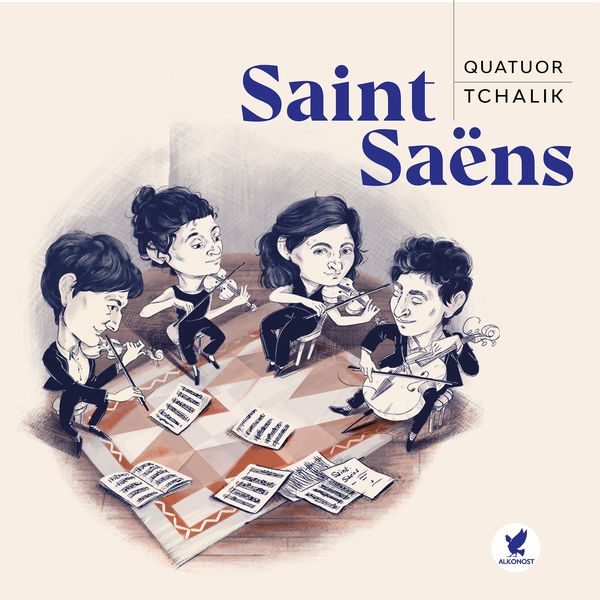
10. Saint-Saëns (Quatuor Tchalik)

Quatuor Tchalik Saint-Saëns

Not even the French made a big deal of the 100th anniversary of the death of Camille Saint-Saëns. But you can be sure of more exuberant festivities when his 200th birthday comes along in 2035. Because Camille’s star is rising. No longer the two-hit wonder of Carnaval des animaux and Danse macabre. No longer the old-fashioned opponent of progressives such as Debussy. But an exceptionally talented composer whose oeuvre is as bounteous as his beard.

Camille Saint-Saëns

These string quartets were written in 1899 and 1918. While the times were very much a-changin’ in the world of music, Saint-Saëns stuck to the principles he believed in: beautiful melodies, clear formal structures and neatly dosed pathos. All perfectly conveyed in this recording by Quatuor Tchalik.

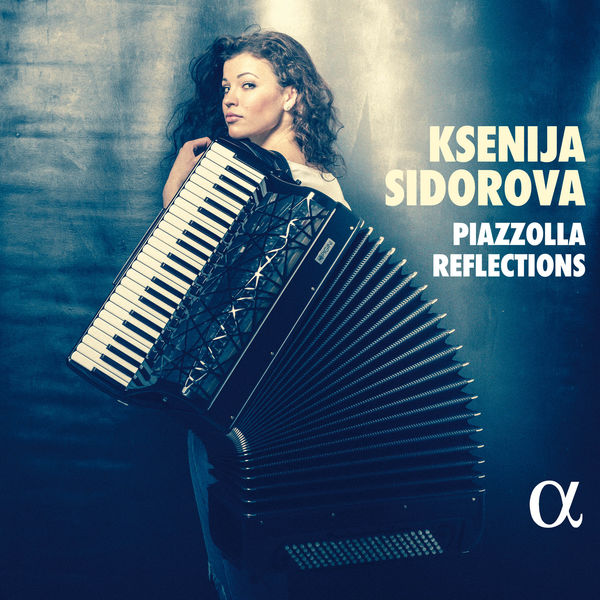
9. Piazzolla Reflections (Ksenija Sidorova)

Piazzolla Reflections (Ksenija Sidorova)

Another composer we celebrated this year is Astor Piazzolla – who was born in the year Saint-Saëns died. During Piazzolla’s lifetime, the opinions about his work diverged. For some, he betrayed the authenticity of the tango. For others, he didn’t deviate from it enough to be taken seriously as a ‘classical’ composer. As time goes by, such considerations lose more and more of their importance. Which is why Piazzolla’s star is also on the rise.

Be that as it may, I think all that tangoing can get a bit tedious – especially for a whole album. That’s why it’s nice that Sidorova pairs Piazzolla’s compositions with works from other composers that are often a bit more adventurous. And that she gives plenty of room for musicians from different backgrounds (jazz, world music) to shine.

But the absolute highlight is an exhilarating performance of Piazzolla’s Concerto for bandoneon and chamber orchestra. Inevitably, this is one of those compositions where he veers more to the ‘classical’ side of his musical persona. But then comes the build-up to the big climax at the end of the third movement: a shy shuffle gradually turns into an outburst of pure passion. And you immediately grasp the unique position this man occupies 20th century music – and far beyond.

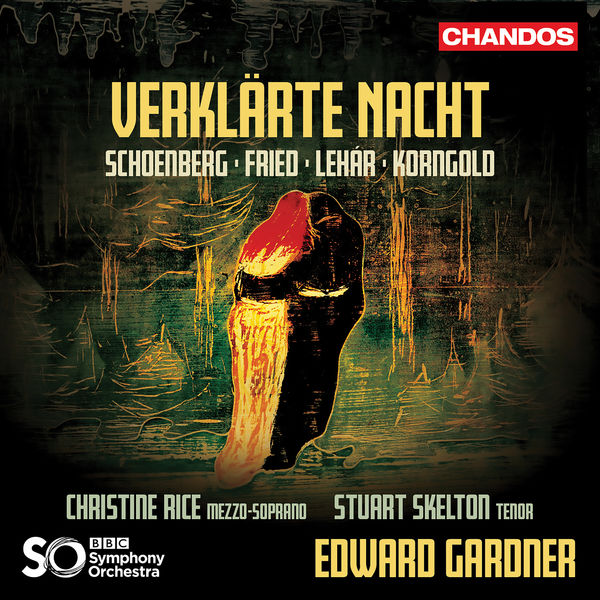
8. Verklärte Nacht – German Orchestral Songs (Edward Gardner, BBC Symphony Orchestra)

Verklärte Nacht - German Orchestral Songs (Edward Gardner, BBC Symphony Orchestra)

A woman and a man take a stroll through a dark forest. She confesses the child she’s carrying is not his. He says that’s fine. That, in a nutshell, is the story of Verklärte Nacht (transfigured night), a poem by Richard Dehmel.

Verklärte Nacht was famously translated into music (for string sextet – no voice) by Arnold Schoenberg before he turned atonal on us. This recording pairs that version with another one (with mezzo-soprano, tenor and orchestra) by Oskar Fried. They’re both beautiful examples of late German romanticism – pulling out all the stops regarding orchestration and daring post-Wagnerian harmony. You can easily understand why Schoenberg thought there was nowhere left to go – even if you don’t like his solution. The songs by Erich Wolfgang Korngold that round off this album demonstrate there were different roads to take.

But the big surprise on this record is Fieber by Franz Léhar. Yes, the Franz Léhar who wrote operettas like Die lustige witwe and was Hitler’s favorite composer (Adolf claimed it was Wagner, but Léhar was what he actually listened to).

Léhar’s contribution might be less sophisticated than those of Fried, Schoenberg and Korngold. It’s essentially a tearjerker about a dying soldier during the first world war (written in 1915). But that ending – “Herr Stabarzt, der Kadett vom Bette acht is tot” – sends shivers down my spine every time I hear it. I know I’m being emotionally manipulated but can’t resist reveling in it.

7. Otaka: Piano Concerto & Symphony “Au-delà du temps” (Live) (Junichi Hirokami, Japan Philarmonic Orchestra)

Otaka: Piano Concerto & Symphony "Au-delà du temps" (Live) (Junichi Hirokami, Japan Philarmonic Orchestra)

Atsutada Otaka died 100 years after the death of Saint-Saens and the birth of Piazzolla. If you’ve been paying attention, you realize that means he passed away this year.

Just like Saint-Saëns and Piazzolla, he studied in Paris. And that’s about all I can tell you – since the non-Japanese part of the internet I rely on for my musicological research doesn’t have a lot to say about him.

Luckily, his music speaks loud and clear. Especially the piano concerto is a tremendous example of the rhythmic vitality that characterizes so much of the best 20th and 21st century music. It mainly reminds me of Stravinsky, Gershwin and Glass. But that might be because I don’t know enough about Japanese music. This recording powerfully demonstrates why fixing that should be one of my new year’s resolutions.

6. Mozart Momentum – 1785 (Leif Ove Andsnes, Mahler Chamber Orchestra)

Mozart Momentum – 1785 (Leif Ove Andsnes, Mahler Chamber Orchestra)

This album consists of compositions:

  • written by Wolfgang Amadeus Mozart …
  • during his most productive year …
  • performed by one of the greatest pianists of our time …
  • who also turns out be a wonderful conductor.

And that’s all I have to (need to) say about it.

5. En Albion: Medieval Polyphony in England (Paul Van Nevel, Huelgas Ensemble)

En Albion: Medieval Polyphony in England (Paul Van Nevel, Huelgas Ensemble)

2021 was also the year of The Beatles: Get Back – a valuable addition to the already mythic story about four British lads who changed the history of music. A similar thing happened about 600 years earlier, when the works of – largely unnamed – English composers became all the rage on the continent and catalyzed the transition from the musical Middle Ages to the Renaissance.

Commentators from that time praised English music for its ‘sweet sound’. British composers achieved it through an increased used of sixths and thirds instead of fifths and octaves. And by taking care that simultaneous notes always sounded good together – in contrast to medieval composers who concentrated on nice chords on the beginnings and endings of phrases and didn’t much care about what happened in between.

This panconsonant style was then picked up on the continent by the first generation of Renaissance composers and would be of fundamental importance for the development of Western music – from Beethoven to, yes, The Beatles. But especially during the Renaissance, the ever-greater insistence on frictionless harmony meant that music also became a lot more boring. It lost all the edge that medieval music had.

From that respect, this collection of 14th century English music represents a unique balance between medieval edginess and Renaissance sophistication. It’s performed by the Huelgas ensemble, one of the pioneering and still most respected ensembles of early music. I generally find them a bit too tame and reverent when performing renaissance music. But in this recording, Paul Van Nevel takes a looser approach – playing around with voice arrangements to build dynamic structures and adding some unusual embellishments.

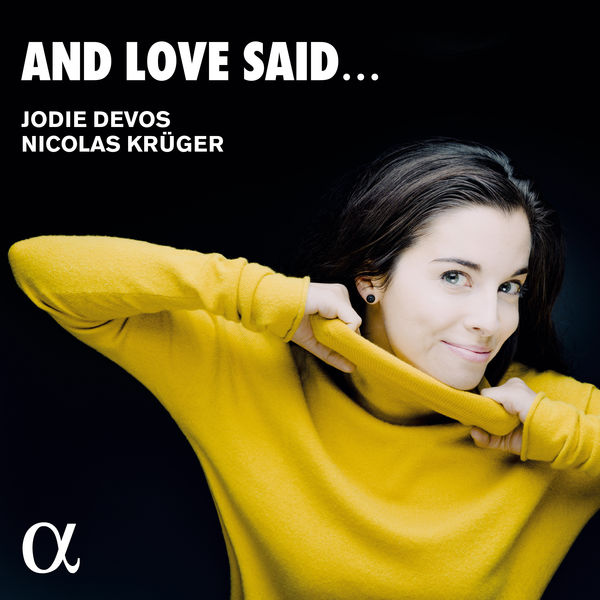
4. And Love Said… (Jodie Devos, Nicolas Krüger)

And Love Said... (Jodie Devos, Nicolas Krüger)

Did the English produce any other music of merit between the 1300s and the 1960s? Some might argue that they didn’t, especially since their one ‘big name’ was a German import. They would, of course be wrong – as Jodie Devos demonstrates through this collection of wonderful songs by – mainly – English composers from the early twentieth century such as Ivor Gurney, Benjamin Britten and William Walton.

Most of all, this record distinguishes itself by containing the most beautiful note of 2021. It’s at 2:13 of track 12 – Let the florid music praise by Benjamin Britten. On ‘hour’, Devos produces a tone (I think it’s a blue note) that threatens to snap all your heartstrings at once.

Extra points for the cover of Freddie Mercury’s You take my breath away. It proves that pop interpretations by classical musicians don’t need to be cringeworthy.

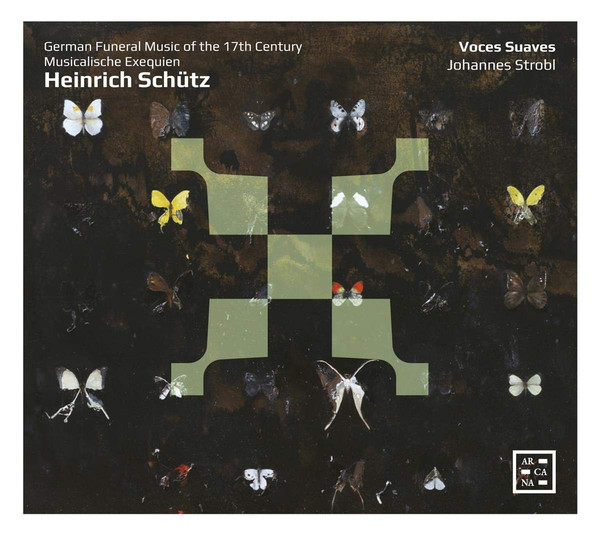
3. Schütz: Musicalische Exequien. German funeral music of the 17th century (Johannes Strobl, Voces Suaves)

3. Schütz: Musicalische Exequien. German funeral music of the 17th century (Johannes Strobl, Voces Suaves)

One of the things we all know about J.S. Bach is that he made a synthesis of all the music that preceded him. Maybe that’s why I never paid much attention to 17th century music, thinking I could just as well listen exclusively to Bach instead.

Boy, was I wrong. Since I dived into the works of people like Purcell, Rameau, Biber, Schütz and Schmelzer, I realized there’s yet another treasure trove of music that I will never be able to fully unpack. This collection of German funeral music is full of the harmonic eccentricities that were ironed out by the time Bach and Handel wrote their choral masterpieces.

Schütz is the biggest name here, but I was especially blown away by the first track: Ich will schweigen by Johann Hermann Schein. It’s extraordinary to think that such a masterpiece was ‘Gebrauchsmusik’ – meant to be played only once and then, well, taken to the grave.

2. Summertime (Isata Kenneh-Mason)

Summertime (Isata Kenneh-Mason)

2021 was the year when identity politics – or wokeism if you like – fully entered the world of classical music. That leads to toxic debates such as the imaginary cancellation of Beethoven. But also to a long overdue reevaluation of composers from disadvantaged groups such as women and people of color.

From that last category, I especially like Samuel Coleridge-Taylor, a turn-of-the-century English composer who was actually quite popular during his lifetime – mostly for his oratorio Song of Hiawatha. Maybe his ‘fall from grace’ has more to do with his musical style than the color of his skin. He composed in the tradition of Dvorak and Brahms, without advancing it very much. But isn’t ‘progressism’ another noxious ideology that the classical music world should leave behind?

Some of Coleridge-Taylor’s biggest fans came from the African-American community. When he learned of the sorrows of his brothers and sisters across the ocean – and discovered their music – he was extremely touched. His version of the spiritual Sometimes I feel like a motherless child, so soulfully performed by Kenneh-Mason, is a heartbreaking testament to that.

That track alone would be enough to put this record in my top ten. What launches it to the second spot is the inclusion of an equally impressive – yet completely different – work: Samuel Barber’s piano sonata. This is an extremely complex work that even uses – yikes! – some 12-tone rows. And nevertheless I was completely sold after no more than two listens. Remarkable!

1. Eilífur (Viktor Orri Árnason)

Eilífur (Viktor Orri Árnason)

If you care about making classical music less white, Iceland probably isn’t the best place to look. But it’s undeniable that there’s something in the water of this volcano-ridden Viking hide-out that inspires musicians who effortlessly skate between pop, post-classical and avant-garde.

Not all of that music is to my taste. I love Björk, but never understood the attraction of Sigur Rós or Jóhann Jóhannsson. ‘Atmospheric’ is the word that’s most often used to describe their music. And while that makes for a perfect aural backdrop during sauna sessions, my attention quickly starts to drift away from the music. Which – I know – is probably exactly the point.

But once Árnason grabbed my attention, he never let go. He constantly plays around with his imaginary orchestra (different instrumental groups and voices were recorded during different sessions) to mix up the texture. Neoromantic strings and winds – sounding like Bruckner from under 15 meters of ice – are combined with an eerie avant-garde choir. In The thread a solo viola plays the saddest motif you can imagine. In The vision an ensemble of woodwinds weaves a brittle contrapuntal structure. There are ominous drones, syrupy fragments, impressive crescendos and sudden silences … Always something happening and yet beneath it all is a constant all-pervasive quality, a … – what should I call it – atmosphere!

Its booklet reveals that Eilífur – which means eternal – is a concept album. It conveys what life would be like if (when?) we all live forever. To me, it sounds like a state of limbo where we oscillate between hope and fear. A fitting tribute to 2021.

Want to keep up with my classical musings? Enter your email address and click subscribe.

Appalachian Spring by Aaron Copland

From Vivaldi and Haydn to Stravinsky and The Beatles, the joy that comes with the return of spring has inspired great pieces of music. And if you wouldn’t know any better, you’d think Aaron Copland’s Appalachian Spring is one of them.

It starts with a clarinet and flute that timidly play three notes that could – or could not – be the beginning of a melody. Like snowdrops that bud in what could – or could not – be the last of snow. And after some back-and-forths between extasy and doubt, the piece ends with five variations on a glorious Shaker melody – Simple Gifts, which was later also picked up by The Kelly Family for their Lord of The Dance. In the context of Appalachian Spring, it sounds like Copland’s version of an Ode to Joy. Summer is definitely on its way!

But as much as that interpretation makes sense, it’s not how Appalachian Spring was intended. In fact, the work could have been called Autumn in Arkansas and sounded more or less the same.

The story

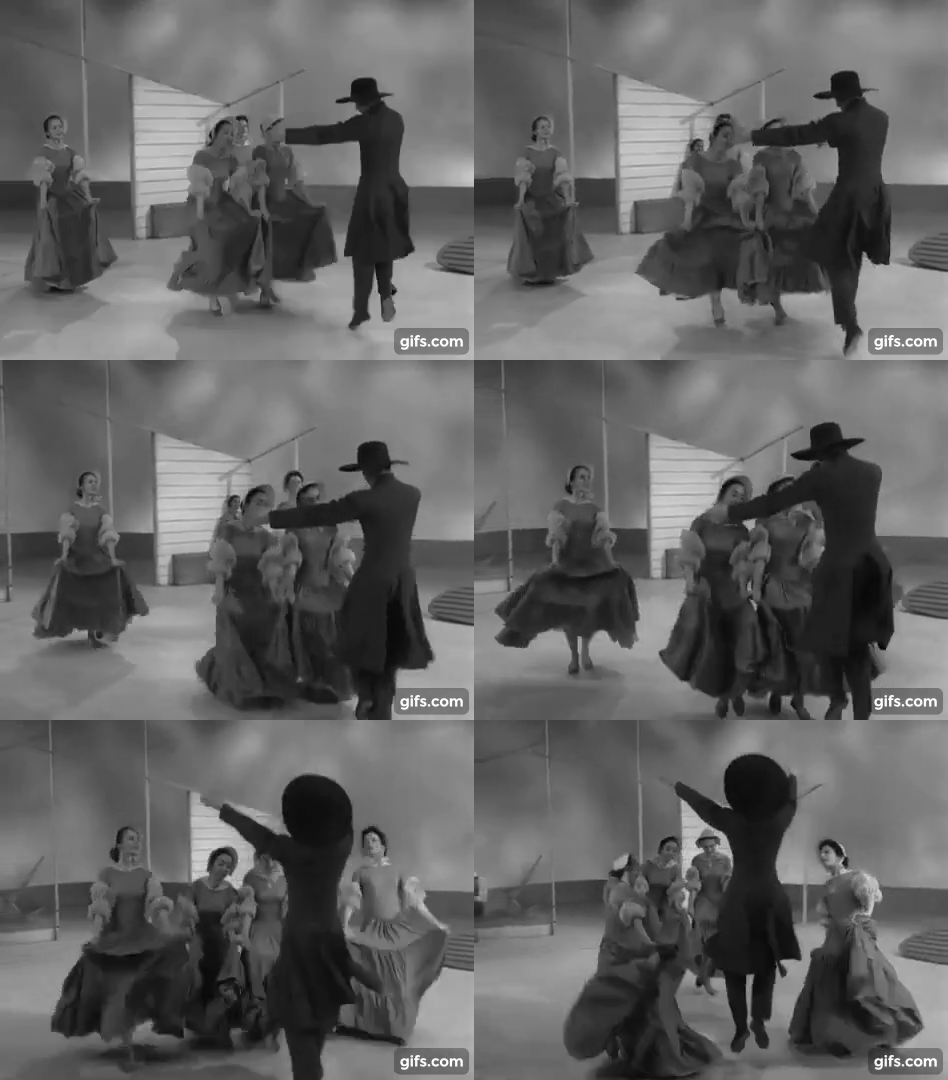
Copland’s Appalachian Spring started as a score for a ballet that was commissioned in 1942. The story was written by choreographer Martha Graham, and it too had nothing to do with spring. Its recounts the day of two newlyweds in pioneer country. And contains a few interesting sidekicks such as a preacher and his congregation.

Seen here congregating. Here’s the full ballet.

In the original version, all these fun and games were interrupted by the arrival of a fugitive slave. But that part was eventually changed to a dance solo by the possessed preacher. The end result is more a loose string of tableaux than an actual plot.

And the name? Martha Graham came up with it when the music and choreography were already finished. She took it from a poem by Hart Crane – simply because she liked the sound of it. Moreover, the poem refers to a natural water source, not the season of new beginnings.

Capturing the American soul

Maybe it’s because of its flimsy story, but Appalachian Spring – first performed in 1944 – immediately became widely popular as a sort of parable for the post-war American spirit of renewal. Copland’s pleasant and seemingly uncomplicated musical language was the perfect complement to the cast of rural characters eagerly displaying their moral fortitude. Appalachian spring was exactly the kind of artwork that could inspire a nation destined to become the leader of the free world.

In a way, this was what drove Copland throughout his career: defining an American form of art music – sometimes derived from popular and folk idioms such as jazz or Shaker hymns. It’s a bit of a nationalist agenda, from an era when nationalism was not exclusively linked to the political right. As an active communist, Copland wrote his ‘populist’ music as a tribute to the dignity and authenticity of the common man, in opposition to the soulless cultural products of the capitalist mass media. You could say he was a highbrow Woody Guthrie.

Aaron Copland, composer of Appalachian Spring.
Aaron Copland in 1946. Presumably during a blackout.

Wholesome orchestral suite

But in post-war America, there was no need for left-wing populism, or left-wing anything for that matter. As a Jewish homosexual communist, Copland ticked all the boxes to be summoned to the McCarthy hearings. He managed to talk himself out of serious sanctions, but wisely kept a low political profile for the rest of his career.

Meanwhile, his orchestral suite based on the ballet score of Appalachian Springs soared in popularity. Far from an incitement to class warfare, it was considered a wholesome piece of Americana. Copland had indeed defined the American sound, but it was now used as musical shorthand for the shiny city on the hill where anyone could make it through hard work. Just listen to the music in this iconic Ronald Reagan commercial:

Versions of Appalachian Spring

For the intellectual classes of the United States, and especially post-war Europe, everything with mass appeal conjured up the trauma of what masses were capable of when they fell into the hands of a ruthless leader. They pretended to listen to Boulez and Stockhausen and had no time for ‘commercial’, even ‘regressive’ music such as Appalachian Springs. It’s only since accessible music came back into fashion that the work is universally considered to be one of the masterpieces of the twentieth century.

And yet, there are some who feel that Appalachian Springs – the orchestral suite – doesn’t have enough depth. Or that it lacks authenticity. They have two solutions for this:

  1. Go back to the original chamber ensemble, with nice results such as the reference recording by the Orpheus Chamber Orchestra or more this more recent version by Ensemble K.
  2. Put the music back in that Copland removed when he turned the ballet music into a suite. The logic being that this fragment – originally meant to accompany the fugitive slave – is a dark interlude that adds much-needed drama to the musical development. Michael Tilson Thomas is a big proponent of this idea. Christopher Hogwood embraced it is as well. I’m not a fan. The reinstated music is indeed dark(ish), but also kind of boring. And it breaks the wonderful flow of the Simple Gifts variations.

The ultimate version

In the end, it doesn’t matter which version they choose to perform. The definitive recording was made almost 60 years ago. No, it’s not directed by the man himself. In his recordings of Appalachian Spring, I feel Copland goes too much out of his way to demonstrate how sophisticated this deceivingly simple music is – making sure you don’t miss any of the individual threads that make up the dense musical fabric.

Copland’s good friend Leonard Bernstein, on the other hand, just wants to make as much of an emotional impact as he can. Contrapuntal subtleties be damned, his recording with the New York Philharmonic simply blows you away. Literally, because the sound of the brass is especially exhilarating. The audio quality of this recording is astounding, especially for that time.

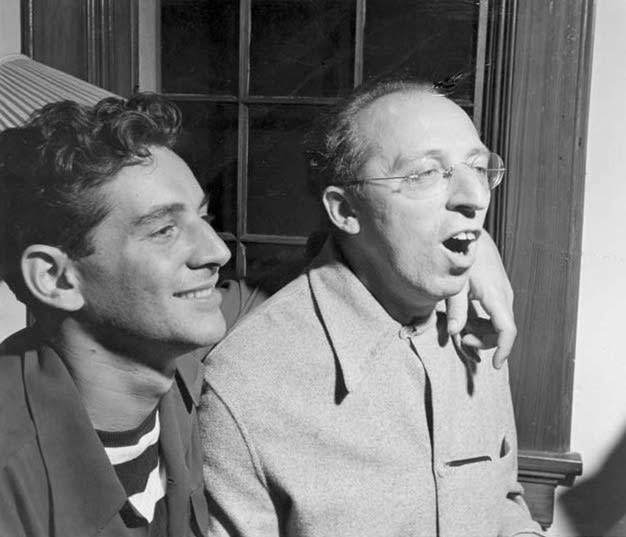
Leonard Bernstein and Aaron Copland
Bernstein and Copland comparing dental work in 1945.

Bernstein pulls no punches. The slow parts crawl by and sound lusciously romantic, while he accelerates to warp speed when he needs to. What Bernstein understood better than Copland – and many other directors – is how to breath life into the dance rhythms that characterize large portions of the work. They’re supposed to evoke square dancing, but Copland doesn’t so much seem to channel the pioneer time as the Brooklyn melting pot that he grew up in. This is truly American music, after all.

Just listen

Hungry for some more classical Americana? Check out Missy Mazzoli’s pioneer opera Proving Up.

Want to keep up with my classical musings? Enter your email address and click subscribe.

More about 20th century music