Richard Wagner’s Siegfried

As every classical music lover must do at least once in their life, I’m attending Wagner’s complete Ring over two years. Because one does not simply walk into a world of gods, giants, dwarfs, dragons, and incestuous relationships, I’ll do my homework before every installment – and share it here. Part 3: Siegfried.

Another 17 years have passed since the events depicted in Die Walküre. Giant-turned-dragon Fafner sits contently on the gold that was stolen in Das Rheingold. But in the same forest, not too far from his cave, there grows a menace to his carefree existence.

That menace is Siegfried, son of Siegmund and Sieglinde, grandson of Wotan and Erda, and one of the most unlikeable people to ever set foot on an operatic stage.

The first action hero

That Siegfried is such a disappointing character is not a minor defect. After all, Wagner’s Ring project started as a single opera named Siegfried’s Tod, which later became Götterdämmerung. The other three instalments were tacked on because Wagner felt Siegfried’s backstory could use some fleshing out.

Siegfried was, therefore, supposed to be the main hero of the Ring. In Wagner’s imagination, he is the “man of the future”, “the most perfect human being”.

He wasn’t only referring to Siegfried’s personality. Wagner described him as:

“a beautiful young man, in the shapeliest freshness of his power, the real naked man in whom I was able to discern every throbbing of his pulse, every twitch of his powerful muscles.”

Siegfried Wagner action hero
Behold, the man of the future.

Unsurprisingly, Siegfried was something of an icon for the fin-the-siècle gay scene, of which, fittingly, Wagner’s son Siegfried was a closeted member.

The problem is that people with such a level of perfection are inevitably boring. Why should we care about the ‘heroic’ deeds of a guy who’s not only borderline invincible but also knows no fear? Without fear, there’s also no bravery. Siegfried just goes around killing foes and dragons left and right without a second thought – like a less entertaining Chuck Norris.

But before you think Siegfried is no more than a cardboard action hero, let me assure you that his personality also harbors a dark undercurrent.

Siegfried and Mime

The opera’s first act is set in the workshop of Mime, the brother of Alberich, whom we met a mere seven hours ago. Mime has taken up the role of single father since Siegfried’s birth. His plan is to use the strong and fearless Siegfried as his tool to kill Fafner and steal the gold.

Siegfried, however, isn’t aware of this plan, which makes his behavior towards Mime rather troubling. He’s constantly belittling him and even brings a live bear into the house just to sadistically scare his pants off.

Wagner Siegfried bear
That’s right, a bear!

You kind of agree with Mime expecting more gratitude from his adoptive son.

It gets worse when you consider the reason for Siegfried’s vileness. He’s not rebelling because of Mime’s actions, his thoughts, or even his character. At this point in the story, he’s unaware of all of that. He simply despises the dwarf for how he looks.

It’s when Siegfried first admires the reflection of his own ripped body, strong jawline, blond curls and baby-blue eyes in a forest pond, that he first realizes he cannot be Mime’s real son. Mime is small, ugly, and talks with a high-pitched whiny voice. He’s also constantly busy making dinner and doing laundry, instead of doing manly stuff like catching bears.

Wagner modern Mime
What an embarrassment.

For Wagner, Siegfried’s hate for this effeminate and ugly dwarf is natural and just; it needs no further justification. It’s the dramatization of a racist worldview that’s as unambiguous now as it was then. In the words of Gustav Mahler: “I know only one Mime, and that is me!”

Mime and Wotan

We immediately witness what a loser Mime is at the beginning of Act 1. Accompanied by the hammering Nibelungen music we remember fondly from Das Rheingold, he’s trying to forge a sword strong enough to butcher Fafner with. But Siegfried effortlessly breaks it in two.

Siegfried forces Mime to tell him who his real parents are. After he tells the story of Siegmund and Sieglinde, Mime shows Siegfried the pieces of Siegmund’s sword Nothung. Siegfried orders Mime to reforge it. Mime fails again; Siegfried leaves angrily.

Another old acquaintance enters, cleverly disguised’ as an old wanderer.

Wotan the wanderer

Wanderer Wotan asks Mime for some hospitality. After Mime refuses, he challenges the dwarf to play a game. He’s allowed to ask three questions. If Wotan is unable to answer them, the god will promptly lose his head.

These pitiful questions are all Mime can come up with:

  1. What race lives beneath the ground?
  2. What race lives on the earth?
  3. What race lives in the skies?

With a resounding ‘duh’, Wotan answers each question correctly: the dwarves, the giants, and the gods. He then turns the tables and demands that Mime answers three questions correctly or face death. Despite having nothing to gain and everything to lose, Mime agrees with the wager.

Wotan’s questions, however, are slightly more challenging:

  1. What race does Wotan love most but nonetheless treat very unfairly?
  2. Which sword can destroy Fafner?
  3. Who can repair that sword?

Mime knows the answer to questions one and two: the Wälsungs and Nothung. But he draws a blank on question three. Wotan reveals that Nothung can only be reforged by someone who knows no fear and – spoiler alert! – he leaves it up to that person to take Mime’s head.

Swordforger

Having received the news about his upcoming decapitation, Mime is understandably upset. But when Siegfried returns, he sees a simple way to escape his fate. Obviously, Siegfried is the fearless hero destined to kill him. So just teach him fear, and problem solved.

What better way to teach Siegfried how to fear than to introduce him to Fafner? As a bonus, he can steal the gold while he’s there and give it to Mime. Brilliant!

Although you might say this whole detour has been stupid because that was Mime’s plan for the last 17 years anyway. And you would be completely right.

The first act ends with Siegfried successfully reforging Nothung. Meanwhile, Mime brews a drink to poison Siegfried once Fafner is killed.

This so-called ‘forging song’ is the first musical high point of the opera. While the orchestra evocates the quivering flames and the rhythms of the anvil and the bellow, and Mime schemes in the background, Siegfried goes in all-out hero mode with relatively simple, repetitive melodies with a lot of leaps to showcase his boundless energy.

Not for the first or last time during the Ring, the music lends credibility to the story’s dubious claims. Here, Siegfried transforms into a hero before our eyes and ears, not through his actions or words, but through the musical magic wand that God somehow allowed Richard Wagner to wield.

Dragonslayer

Who’s that whining in front of the entrance to Fafner’s cave at the beginning of the second act? It’s Alberich the evil dwarf, Mime’s brother, and the original thief of the rhinegold. He’s waiting for the dragon to perish so he can take back the ring.

He’s joined by Wanderer Wotan, for no better reason than to tease his arch enemy a bit. He tells Alberich he’s not there to steal the gold, just to witness the events to come: not Wotan, but his own brother Mime will be Alberich’s contender for the gold. In typical Wagnerian fashion, he comes to warn the dwarf, then leaves the stage with a ‘que sera sera’ – events will unfold no matter what.

Wagner rage
THEN WHAT WAS THE POINT OF YOUR ENTIRE WARNING SPEECH?!

On the next daybreak, Siegfried and Mime arrive at Fafner’s lair. Mime wishes Siegfried good luck. Siegfried tells Mime to get lost. Then, our hero lays himself under a tree to wait until the dragon comes out for a drink.

We now encounter another aspect of Siegfried as the ideal romantic man: his close connection to nature. While the orchestra conjures up a tapestry of babbling brooks and rustling leaves – known as the Forest Murmurs – Siegfried tries to communicate with birds by blowing on a reed, although ultimately failing.

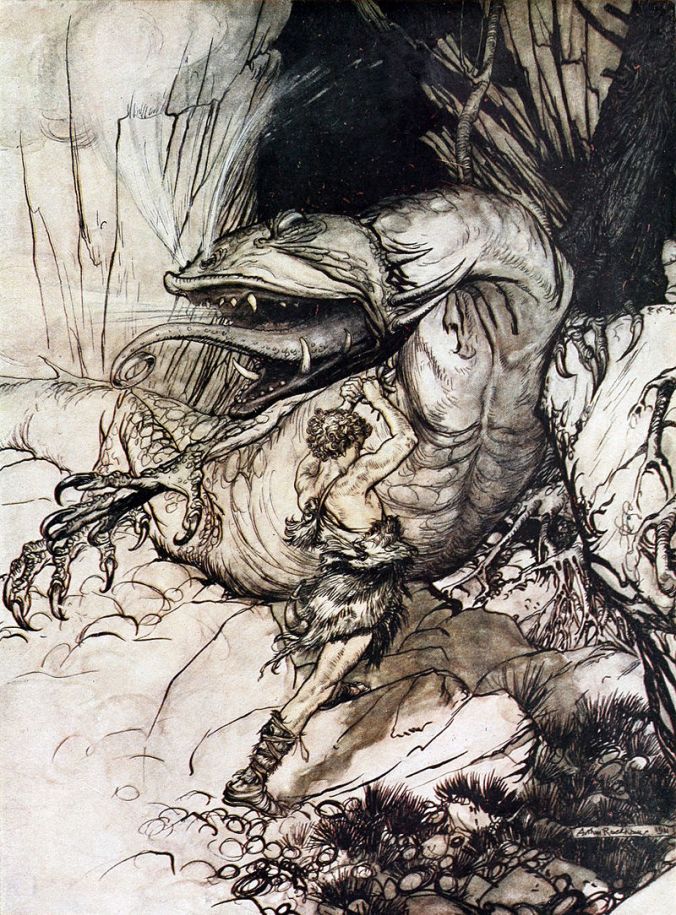
He immediately speaks Fafner’s language, though. When the dragon comes out of his lair, the two engage in a minimum of conversation (“I’m going to eat you.” – “No, you’re not.”) before their fight. Unsurprisingly, Siegfried effortlessly slays his foe with a stab through the heart.
Wagner Siegfried dragonslayer

Fafner is surprised and impressed by this “boy’s” courage and strength. With his dying breath, he gives a final warning: “Whoever blindly put you up to this, is also plotting your own death.” Is he talking about Mime, or is it possible that this key moment in the tetralogy holds a deeper meaning? Could the “blindly” refer to a one-eyed friend who foolishly created Siegfried to fulfill his own selfish desires?

Dwarfslayer

Although killing a dragon always looks nice on a pseudo-medieval résumé, it brought Siegfried no closer to understanding fear. He’s about to learn something else though. Some of Fafner’s blood has landed on Siegfried’s finger. When he licks it off, he’s suddenly able to understand the language of birds. One of them urges him to enter the cave where he will find the gold of the Nibelungen. However, the Tarnhelm will prove far more useful, and the ring would make him lord of the world.

When Siegfried goes into the cave, Mime reappears. He’s immediately joined by his brother Alberich, and they start a kind of rap battle about who’s more entitled to ‘rightfully steal’ the treasure.

As Siegfried reappears with the tarnhelm and the ring, the two dwarfs immediately flee and hide. The bird warns Siegfried that Mime wants to kill him. Luckily, the same dragon blood magic that enables Siegfried to understand birds will also allow him to hear the true meaning behind Mime’s treacherous talk.

Just like the previous encounter of Alberich and Mime, the next dialogue between Mime and Siegfried is an example of great musical comedy. While the music expresses the dwarf’s groveling tone, the words betray his murderous intentions. It’s a mismatch that will certainly put a smile on your face, as long as you don’t think too hard about how Wagner’s depiction of a two-faced dwarf rhymes with his views on certain members of the human race.

Siegfried, in any case, doesn’t appreciate the joke much. He kills Mime as foretold by Wotan, and buries him in Fafner’s cave, both forever united with their precious gold.

This afternoon of double murder leaves Siegfried anything but content. He still hasn’t learned fear and is now totally alone in this world. Luckily, his feathered friend knows the solution: a beautiful woman sleeping on a rock, encircled by flames and waiting to be woken by a hero who knows no fear.

Spearshatterer

The third act of Siegfried starts with two scenes of the kind that are seriously testing my patience as the Ring goes into its final hours. First, Wotan wakes up earth-goddess Erda to ask him how “the cruel wheel of fate can be stopped.” Apparently, he means the end of the Gods, but it’s not clear where he got that idea from. Erda tells him destiny is fixed, something that Wotan reproaches her for (although he said this himself to Alberich barely thirty minutes ago).

He then says that, because Siegfried knows fear nor envy, Alberich’s curse has no power over him and he will, with Brünnhilde by his side, redeem the world, even though this will entail the downfall of the gods. As was Wotan’s plan all along.

Nevertheless, when Siegfried shows up in the next scene, Wotan tries to stop him. First, with a barrage of inane questions: where are you going, where do you come from, nice sword – made that yourself? Then, when Siegfried gets understandably annoyed, he tries to block the road by holding up his fabled staff which Siegfried splits in two.

Wagner Wotan Siegfried Staff
“You shall … pass.”

Again, while this scene logically makes no sense (at least not to me, but libraries of books disagree), dramatically it’s another high point. It symbolizes the new order obliterating the old and plays out the universal concept of generational conflict. Wotan’s solemn musical motifs, by now well-known to the listener, are ironically subverted by the young upstart Siegfried. Then the tension rises, and the actual spear-shattering comes with amusing thunder and lightning. Nothing now stops Siegfried from claiming his female companion.

Siegfried and Brünnhilde

Nothing to stop Siegfried except a ring of fire, that is. But as you would expect by now, he effortlessly walks through that. When he reaches the top of the mountain, he notices a person sleeping in full body armor.

He first removes the helmet and sees a man with beautiful long hair. It’s only when he also cuts away the breastplate that he finds out it’s a woman – the first one he ever lays his eyes on. Apparently, Mime didn’t neglect the sexual education of the boy in his care.

Mime and young Siegfried
Rest in peace, you repulsive but diligent imp.

Finally, here’s a creature that Siegfried is genuinely afraid of. To be more precise, he panics because of the feelings she stirs up inside him. He calls out to his mother, which gives the whole thing a creepy Freudian touch.

Assembling his courage, Siegfried kisses Brünnhilde from her sleep. They immediately start to profess their love at first sight, both elaborately praising Siegfried’s mother – which should be a red flag on a first date.

Siegfried wakes Brunnhilde

However, while Siegfried is getting hornier by the minute, Brünnhilde is starting to have second thoughts. Because of Wotan’s punishment in Die Walküre, she’s now a mere, and virginal, mortal. Her armor is now literally taken away, leaving no defense against desires that rage both in Siegfried and herself.

It’s hard to miss the sexual subtext of this scene. This is, after all, written by the composer who had just finished Tristan and Isolde. But the final musical highlight of this opera is something that comes very close to a traditional aria that could have featured in The flying Dutchman. Brunnhilde pleads with Siegfried to leave her in peace and preserve her immaculate image in his memory:

However, the flames of love have already spread beyond control. With a generous portion of ecstatic vocalizing, Siegfried and Brünnhilde declare each other their undying love. The ring is in the hands of a couple that should be able to withstand its corrupting power.
Are these the best classical tracks of 2024?

Probably not. But out of the ones I’ve heard, I’ve enjoyed these the most.

Listen to the Spotify playlist

10. Te Deum: Prélude (Marc-Antoine Charpentier)

Te Deum Charpentier

Featured on: Charpentier & Desmarest: Te Deum (Ensemble Les Surprises)

I considered choosing a less obvious track from this album, but let’s be honest, there’s a reason why this is such an evergreen. That rambunctious opening drumroll followed by those cock-a-hoop trumpets—there aren’t enough words in my thesaurus to describe my exhilaration whenever I hear this.

Nevertheless, I can heartily recommend the rest of the album as well. This recording shines from all angles like a Versailles chandelier. And then there’s the way the singers, doubtlessly for historical accuracy, Frenchify the Latin. So the ‘u’ in ‘laudamus’ doesn’t sound like ‘boot’ but like—well—‘parvenu’ (pronounced in French). Which, for some reason, I find endlessly entertaining.

9. Funeral March for Rikard Nordraak (Edvard Grieg)

Funeral March Richard Nordraak Grieg

Featured on: Grieg: Symphonic Dances (Bergen Philharmonic Orchestra, Edward Gardner)

On to more drums and winds, but less jolliness. This funeral march was written by a young Edvard Grieg to honor his friend and mentor Richard Nordraak, the composer of the Norwegian national anthem who died aged 23 of tuberculosis.

As dictated by convention, this march is a mixture of pomposity, tenderness, and grief. Although you might also detect a pang of guilt. After all, Grieg had ignored his sick friend’s incessant pleadings for a visit out of fear of catching the disease himself.

Towards the end of his life, Grieg always kept a copy of this score in his briefcase, in case there was need for some impromptu serenading when he suddenly dropped dead. It was played at his funeral in the end. If you want it to accompany your own interment, this recording by the Bergen Philharmonic Orchestra will not disappoint.

8. Finale, Presto from Symphony nr. 98 (Joseph Haydn)

Haydn symphony 98

Featured on: Haydn 2032, Vol. 16: The Surprise (Il Giardino Armonico, Kammerorchester Basel, Giovanni Antonini)

I elaborately sang the praises of Haydn this year. So it makes sense to include some of his music in 2024’s overview. And the Haydn 2032 series is so good that I can include it in every year’s list.

This allegro is a perfect illustration of Haydn’s unique approach to composition. It starts with a lighthearted and, dare I say, forgettable melody. But then it branches out to all corners of the emotional spectrum.

The final surprise is a short but lively keyboard solo just when you thought the movement was grinding to a halt. At the premiere in London, this was played by the 60-year-old Haydn himself—never particularly known as a virtuoso. Imagine Bob Dylan suddenly turning into Billy Joel at the piano, and you’ll understand why the baffled crowd immediately demanded an encore.

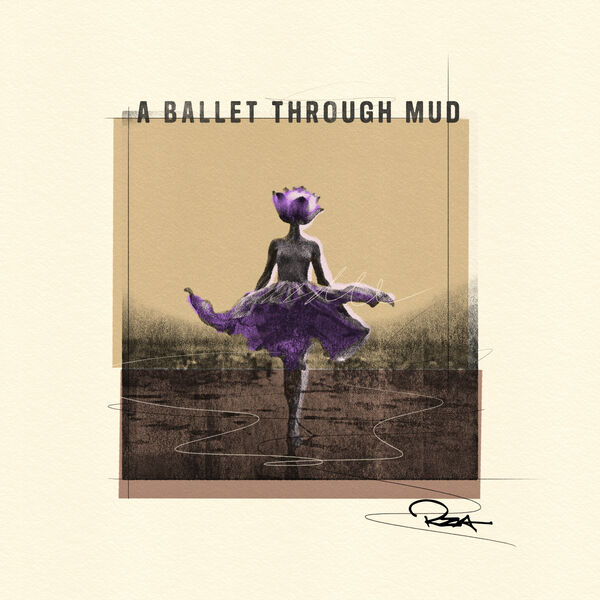
7. A Ballet Through Mud (RZA)

A ballet through mud

Featured on: A Ballet Through Mud (Colorado Symphony)

Speaking of surprises, when I first heard this track in the background, my first guess was Rimsky-Korsakov—mainly because of the obvious quotation from Scheherazade. Turned out the composer was RZA, aka Robert Fitzgerald Diggs, of Wu-Tang Clan fame.

RZA is quite the renaissance man: rapper, filmmaker, actor, composer, and producer. It’s the producer job that brings in the C.R.E.A.M, though. So it’s no surprise that this album, apart from some beautiful melodies, stands out for its amazing orchestration.

6. At the Purchaser’s Option (Rhiannon Giddens)

At the purchaser's option

Featured on: But Not My Soul: Price, Dvořák & Giddens (Ragazze Quartet)

Rarely is there such a heartbreaking story behind an innocuous title. Listen to Rhiannon Giddens tell it and stick around for her mesmerizing performance:

This original version gets its emotional punch from the combination of the laid-back banjo music with Giddens’ dignified and controlled anger.

The string quartet arrangement by Jacob Garchik is more extroverted, releasing all the pain and rage through plaintive countermelodies, plucking on snares, and hammering on wood. No substitute for the original, but certainly a worthy complement.

5. Tuba Mirum (Wolfgang Amadeus Mozart)

Tuba mirum mozart

Featured on: Mozart: Requiem (Pygmalion, Raphaël Pichon)

This one will be on a lot of lists this year. Raphaël Pichon interweaves Mozart’s Requiem with lesser-known compositions by the composer that seem to eerily foreshadow his final work. Certainly interesting, but it’s the amazing performance of the pièce de résistance that will turn this into a classic recording.

In the liner notes, Pichon explains how Mozart’s Requiem is in some ways an extension of his operas, “[elevating] the orchestra to the status of an additional character, [even] the most complex character to convey what could not be expressed in words.”

That’s nowhere more evident than in the Tuba Mirum, an almost operatic quartet with a trombone as the fifth character. But Pichon also brings out the dramatic power of Mozart’s (or is it Süssmayr’s?) string section as a sixth member of the conversation.

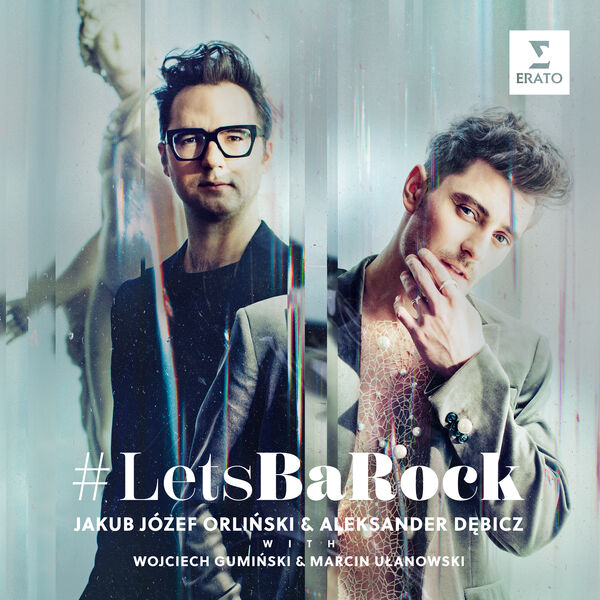
4. Strike the viol (Jakub Józef Orliński/Henry Purcell)

Strike the viol

Featured on: #LetsBaRock (Jakub Józef Orliński, Aleksander Debicz)

Let me get one thing off my chest first.

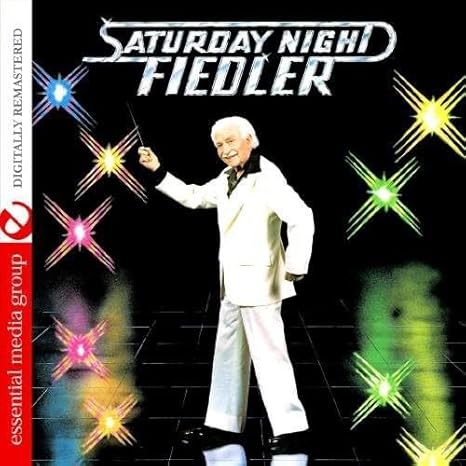
Dear classical music marketing people, I know pop-classical crossover is hard to sell. But let me assure you that album titles such as these only make things worse. It sounds like something that was coined in the seventies.

Saturday Night Fiedler
Good times, but not to be revived.

But wait a minute, I retract my words. I see you’ve added a contemporary touch: the completely meaningless hashtag! An unmistakable sign that you are truly ‘with it’.

Why should I care? Because this is a great album, and it would be a pity if the already tiny potential audience for this sort of thing was put off by this horrible title.

Countertenor Orliński and pianist Debicz bring cover versions of lesser-known baroque tunes and some of their own compositions in various 20th and 21st-century musical garments—ranging from jazz to hip-hop.

The combination of rich stylistic variety and consistent bare-boned instrumentation (mostly just voice, piano, drums, and bass) works extremely well. Just play this track, repress your purist prejudices (in either direction). And admit that it just, well, rocks.

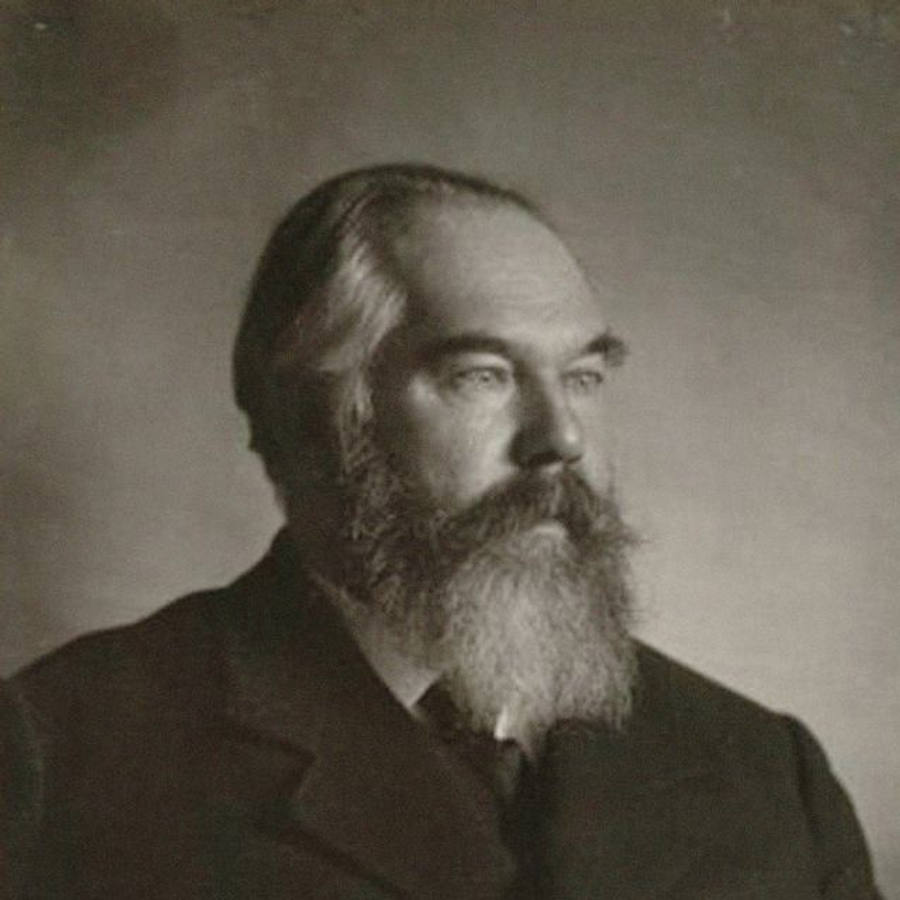
3. Piano Quintet in G Minor: Largo (Sergey Taneyev)

Sergey Taneyev

Featured on: Taneyev: Violin Sonata in A Minor & Piano Quintet in G Minor, Op. 30 (Spectrum Concerts Berlin)

“Unfortunately for Sergei Taneyev, his music has long been held in high respect.” Nothing can be improved about that introduction by Gavin Dixon to this relatively unknown Russian composer. As a pupil of Tchaikovsky and teacher of Scriabin and Rachmaninov, Taneyev is a key figure in the history of Russian music. But he himself was more attracted to the Germanic tradition, earning him the nickname of ‘Russian Brahms’.

Much like Brahms, Taneyev combines strict compositional procedures with soaring expressions of emotion. This largo from his piano quintet is a nice example. It’s written in the respectable baroque form of a passacaglia, where one melody (presented very dramatically in unison at the beginning) is repeated throughout the movement. It’s a strong anchor for a deep dive into the innermost depths of the human soul—classical romanticism at its best.

This passionate aspect of Taneyev’s music seems to be overshadowed by his reputation as an academic traditionalist. His uneventful personal life might also have something to do with it. A lifelong bachelor, the closest he came to scandal was when Tolstoy’s wife took a shine to him. She wasn’t particularly subtle about it, which enraged Tolstoy. Nevertheless, the whole thing completely passed by Taneyev’s notice.

Maybe all that emotional torment in his music had no basis in real life. Or maybe his ‘lifelong friendship’ with Tchaikovsky was more complicated than most bios would have us believe. In that case, I hope someone discreetly informed poor Mrs. Tolstoy.

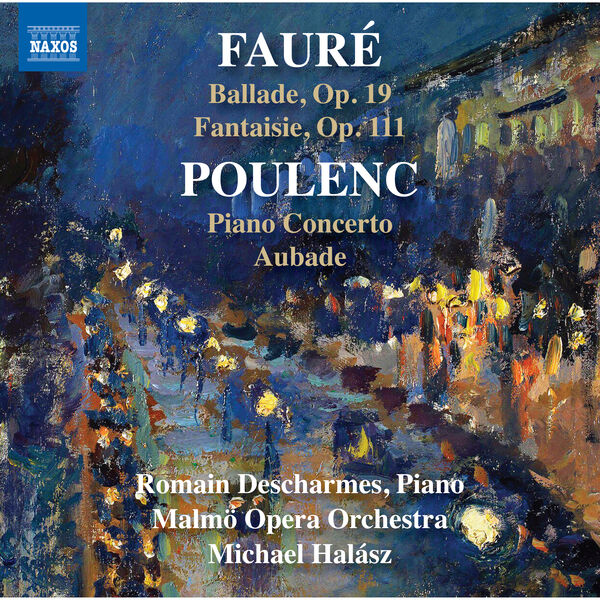
2. Piano Concerto in C-sharp Minor: Allegretto (Francis Poulenc)

Poulenc piano concerto

Featured on: Fauré & Poulenc: Works for Piano & Orchestra (Romain Descharmes, Malmö Opera Orchestra, Michael Halász)

“Half monk and half naughty boy.” Now that’s more like it. It’s how critic Claude Rostand described Francis Poulenc, a composer who’s often derided for not being sufficiently serious. Understandable, when you listen to this first movement of his piano concerto, where he even outdoes Haydn in his constant thwarting of our expectations.

Maybe it’s a bit much and the whole thing misses a sense of unity. But his gorgeous melodies are unsurpassed by anyone but Mozart or Schubert. I couldn’t get the main theme out of my head for at least a week.

And then there’s that solemn brass chorale around the 6-minute mark, dialoguing with the piano and strings. Poulenc lets the seductive main theme kick in again with scarcely any transition, bringing the monk and the naughty boy face to face and creating a moment of sublime beauty.

1. Violin Concerto, Op. 15: II and III (Benjamin Britten)

Violin concerto Benjamin Britten

Featured on: Britten: Violin Concerto, Chamber Works (Isabelle Faust, Symphonieorchester Des Bayerischen Rundfunks)

In 1939, Benjamin Britten arrived in the United States seeking refuge from the rise of fascism and militarism in Europe. His subsequently written violin concerto is therefore often regarded as a commentary on those troubled times.

Some say the young Britten went a little overboard with this concerto. The orchestra (especially the percussion section) is unusually large, and the violin part extremely demanding. It’s hard to imagine how some of the parts of the cadenza at the end of Part II can be played without at least one extra hand.

It’s impossible to separate these two movements: there’s no break between them and the theme of the passacaglia of Part III (a simple rising and then descending scale) is foreshadowed in Part II.

The general mood of Part II is one of terrible, beautiful violence (something that can only exist in art), reminiscent of Beethoven’s Ninth Symphony. There’s no triumph in Part III though, only resignation without acceptance.

It’s easy to imagine Britten writing this in 2024. But where would he escape to?

Who invented classical music?

Who first created classical music? Ask ChatGPT, and you’ll get a correct but boring answer. Something about classical music having “a rich and diverse history, shaped by numerous composers and musical developments.” Big snore.

Person yawning
This is how generative AI will take over the world: by putting us to sleep with its wishy-washy word salads.

Beethoven and AI: the battle of the superhumans

Ask Google, and the answer will be decisive but wrong.

Who invented classical music

The equally entertaining and correct answer is Joseph Haydn (1732-1809). Here are four reasons why.

1. He had an actual classical music lab

Many world-changing inventions, from penicillin to Keanu Reeves, originated in a laboratory. Classical music is no exception.

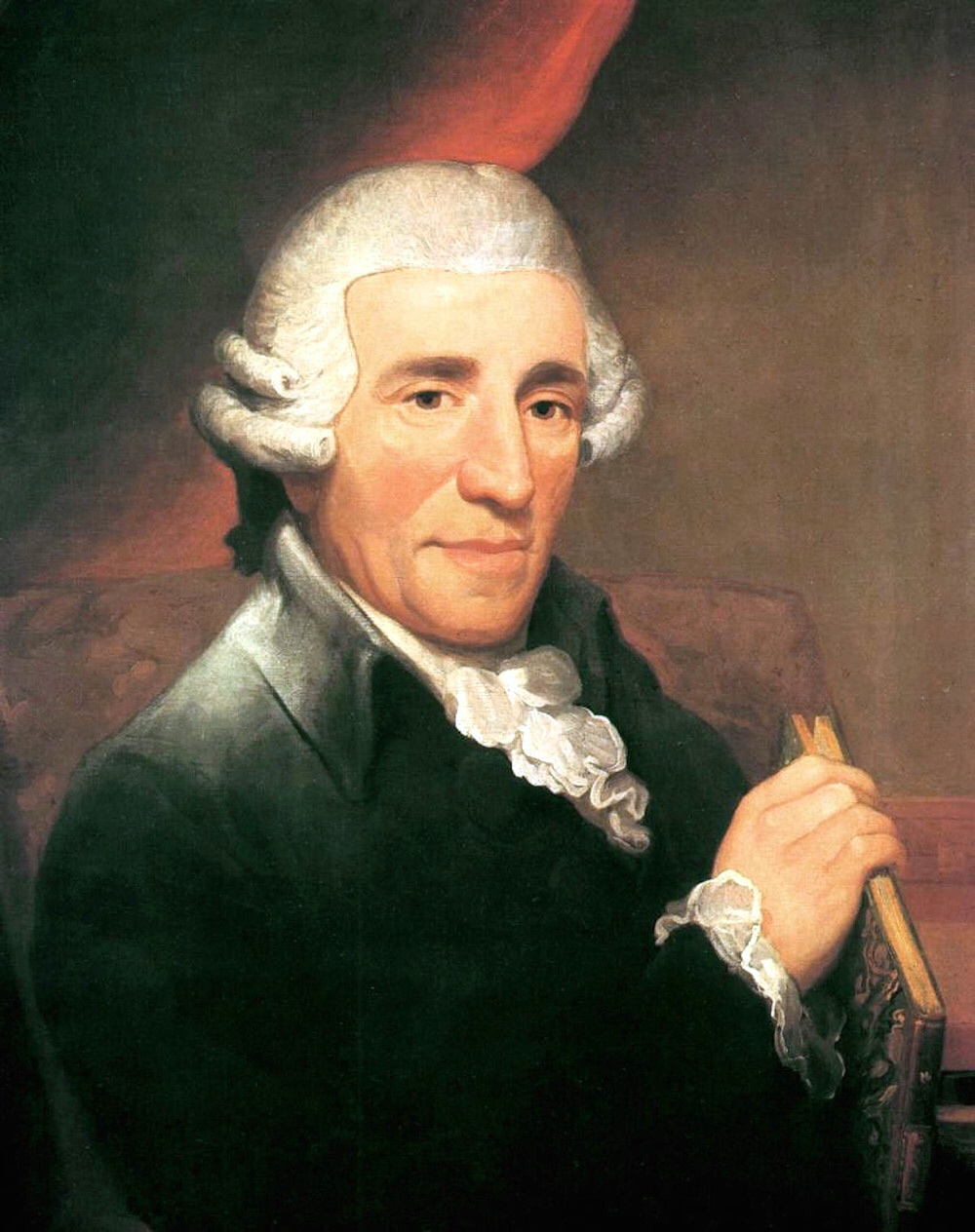
In 1761, then barely 30 years old, Joseph Haydn entered into the service of Prince Esterházy. He would remain there more or less until the end of his life.

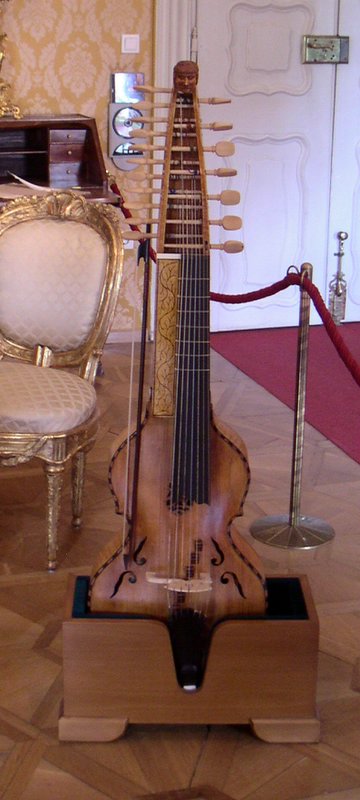
Fans of the ‘free artistic spirits’ of the following generations (Mozart, Beethoven, and so on) often look down on Haydn for his position as a mere servant – with a livery and all. And they’re right that Haydn wasn’t free to follow his muse. He had to cater to the whims of his master, such as writing 175 pieces for an obscure instrument that the count happened to like.

Haydn baryton
This monstrosity looks like the result of an unfortunate night of passion between a cello and a lute.

On top of that, poor Haydn didn’t live in the bustling musical metropolis of Vienna. He spent most of his days in a remote palace erected on top of a mosquito-infested swamp. How was he supposed to keep up with the latest trends?

He didn’t. And his music benefited from it. Or as Haydn himself said in this famous quote:

“I was cut off from the world. There was no one to confuse or torment me, and I was forced to become original.”

In other words – more Doc Brown than Steve Jobs – Haydn preferred tinkering around in his basement above hobnobbing with the musical jet set and stealing their ideas.

It helped that this proverbial basement was excellently equipped. Haydn had one of Europe’s finest orchestras at his disposal for performances and rehearsals. He could test what worked and what didn’t, make changes, and try again. It was a musical test lab that folks like Mozart and Beethoven could only dream of. And it certainly makes you wonder who enjoyed the most artistic freedom.

2. He (sort of) invented the classical style

Haydn is often called the ‘father’ of the symphony and the string quartet. Admittedly, that’s a bit of an overstatement. He obviously wasn’t the first to write a large piece for an orchestra or to come up with the idea of combining two violins, a viola, and a cello.

More to the point, he used these two genres to explore new ways of composing. And that’s where things get a little bit technical, I’m afraid.

Absurd album cover
Here’s a splendid album cover to lighten the mood.

Listen to music by Baroque composers like Bach and Handel, and you’ll find that a single piece of music usually explores one emotion: sad, triumphant, melancholy, and so on. Sometimes two, such as in the ubiquitous Da Capo arias with a contrasting middle section, but that’s about it.

The following generation of composers wanted to combine multiple emotions in one piece. So you quickly go from sad, to angry, to resigned, to happy. The trick is to do this without the whole thing sounding like a toddler with mood swings.

That’s what Haydn mastered through the dozens of symphonies and string quartets that poured out of his musical lab. He found a way to build musical structures that combined a variety of emotions with a sense of balance and logic.

Haydn wasn’t the only one to do that, but he was the best. Without his innovations, Mozart wouldn’t have written his famous operatic finales, nor Beethoven his dramatic symphonies. In this respect, Haydn can truly be considered the inventor of classical music.

Admittedly, this is only true for what late nineteenth-century critics labelled the ‘Viennese classical school’ around Haydn, Mozart, and Beethoven. Not for what we now call classical music, which is everything from Gregorian chant to Ludovico Einaudi.

Nevertheless, it’s no coincidence that this ‘classical’ label first awarded to Haydn gradually stuck to ‘all music that aspires to do more than divert’. Or ‘all music that’s worth to be remembered’. And this brings us to his other great innovation.

3. He invented the classical music ‘masterwork’ culture

Although Haydn stayed in one place for most of his life, his music travelled to all corners of Europe. Unauthorized prints of his scores were in high demand. Soon, the ‘brand’ Haydn was tacked to other people’s works to jack up sales.

You could write an entire article about how the business-savvy Haydn gradually took matters into his own hands. Through hard bargaining with publishers – and some downright fraud – he managed to slice out a nice piece of the pie for himself. In a time, remember, when there was no such thing as copyright.

But for the history of classical music, what happened at the end of his life is more interesting. First, take a look at this graph:

hours of music per composer

That giant bar is Haydn’s musical output during his lifetime. Others don’t come near, and after his death, productivity evidently declined.

Did those young upstarts lack Papa Haydn’s work ethic?

Actually, they followed in his footsteps.

There’s a whole story behind that giant bar. While Haydn wrote a ton of music – 106 symphonies alone – he wrote considerably less during his later years. Because he was tired? Perhaps. But also, because the new Prince Esterházy didn’t ask for as many compositions, while still paying him a generous allowance.

Instead, Haydn started to value quality over quantity.

Wait, that might imply that his former work was bad.

A better way to put it, is that he became more ambitious. Like the rock bands back in the day that started to churn out concept albums once they were rich, bored, or both.

In his later works, including The creation and the Mass in time of war, Haydn is no longer trying to please his master or cater to the whims of the market, he’s writing for posterity.

Happily, this long-term goal didn’t hurt his short-term cash flow. It turned out people were prepared to dig a little deeper in their pockets for such ‘masterworks’. The earnings for The creation started rolling in before the work was even printed, because Haydn used a subscription model where supporters paid in advance for copies of the score. That’s right, he also invented crowdfunding.

Original score of Haydn's creation
The creation was also immediately published in a combined German and English edition, to make sure this unique work could be instantly appreciated by the whole ‘civilized world’ – naturally excluding the French.

At the same time, people were using the Saint Matthew passion manuscripts to wrap fish ‘n chips, The creation was the first composition that was deemed of ‘eternal value’. It immediately popped up on all concert programs and stayed there forever. It was the first entry of what we now call – for better or worse – the standard repertoire.

4. He doesn’t get the recognition he deserves

Joseph Swan invented the light bulb, John Blankenbaker the personal computer. Yet it’s Thomas Edison and Steve Jobs who ended up in the history books. Uncredited pioneers are everywhere.

Haydn isn’t exactly forgotten, of course. But he’s also not in the superstar league of Bach, Mozart, Beethoven, or Chopin. Do you, doubtlessly a classical music connoisseur, disagree with that assessment? Then please whistle a Haydn tune for me.

Now.

I’ll wait.

If you finally came up with the andante of the surprise symphony – congratulations. Also, how predictable.

That famous andante is a good example of why Haydn gets more respect than love. Let’s be honest: the melody is incredibly bland and silly. Compared to the countless Mozart melodies you know by heart, it sounds uninspired. And (divine) inspiration is what we expect from an artistic genius – like Paul McCartney waking up with the tune of Yesterday fully formed in his head.

In some ways, Haydn was more an artisan than an artist. His main drive was to systematically explore the possibilities of music – almost in the scientific spirit of enlightenment. Trivial melodies are actually better suited for that purpose, as they offer a lot more opportunities for development.

Beethoven also knew that. You can’t say that the opening theme of the fifth symphony, for example, is a great find. We cherish it because we know what comes after those 4 notes. What sets Beethoven apart, is that he used these techniques to write pieces of music with an incredible emotional drive. And that, alas, is what’s often missing from Haydn. His music is often a lot more interesting than moving.

Is Haydn still worth listening to?

Has this article convinced you of Haydn’s historic importance but also weary of listening to his music? You’re not alone. And that’s a pity, because there’s a formidable oeuvre waiting for you to – trust me – enjoy. Here are some tips for appreciating Haydn:

Start with works from his middle period

Haydn was very much into Sturm und Drang, an artistic emo movement that was fashionable during the 1760/70s. Many of the works he wrote then are a lot more passionate than his later compositions, and therefore easier on the modern ear.

Examples are symphonies such as the Trauer (no. 44), Farewell (no. 45), and La passione (no. 49); and the six string quartets opus 20 (a big influence on Beethoven).

After that, learn to take pleasure in being amused rather than moved

Haydn is often called the master of humor in music. Unfortunately, that makes him sound like some silly prankster uncle.

Inventor classical music
“Go on, pull my finger to see what I’m hidin’. Get it? Hidin’?!”

But the ‘humor’ in his most mature instrumental works is a lot more sophisticated than the insertion of ‘practical jokes’ like the loud surprise chord in the aforementioned andante. It’s about constantly thwarting your expectations, playing with the conventions that he helped to establish, essentially parodying himself.

Because this is music that actively refuses to ‘pull you in’, it requires a different listening attitude compared to Mozart or Beethoven. You can’t disappear into it; you have to enter into a conversation with it. Even though your part of the discussion will mostly be: “I see what you did there, ol’ chap. Well done!”

Put The creation on your lifelong playlist

Just like J.S. Bach, Haydn was a devout man. His most ‘personal’ music is not about his internal struggles, but about his relationship with God.

But while Bach was a somewhat creepy and antisemitic fundamentalist, Haydn had a more tolerant and optimistic view of religion, and of life. One that illuminates every note in his magnum opus: The creation.

The creation, based on the book of Genesis and Milton’s Paradise lost, is an incomparable celebration of God through the evocation of the beauty of nature and of human love. Its music depicts the cosmological transformation from chaos to order, the separation of heaven and earth, the first sunrise, roaring lions and buzzing insects.

In the hands of a lesser composer, this would sound like sequence of cheap sound effects. But thanks to Haydn’s musical innovations, it all amounts to a coherent whole.

In The creation, there’s no room for doom and damnation. Early on, ‘hellish spirits’ are quickly thrown into the abyss, never to be heard again. Magnificent choirs, inspired by the Handel performances that Haydn heard during his trips to London, beam their joyous and hopeful messages into the world.

Haydn intended for the creation to be his eternal message to the humanity. Paradoxically, no other work is so steeped in the optimism of the Enlightenment. That optimism proved to be less timeless (and warranted) than he had hoped. But it should never completely disappear from view. And neither should classical music’s greatest inventor.

Messiaen’s Turangalîla-Symphonie: big, beautiful, and too long

A few months ago, I got furious at Gustav Mahler. In hindsight, the fault was mostly my own. I voluntarily attended a performance of his second symphony with no intermission, no legroom, and no way to escape.

To divert my mind from the double assault of leg cramps and sleep, I attempted to engage with the music. But each bland melody I tried to follow was quickly overtaken by other themes that were equally uninteresting. They could have been clever variations of each other, but honestly, who cares?

As the concert dragged on, I decided to focus on the percussion section and their amusing logistics of striking the proper noisy apparatus at the right time. But even that wore off after ten minutes.

When the full-scale choir started their pompous preaching about redemption and resurrection, I well and truly had enough.

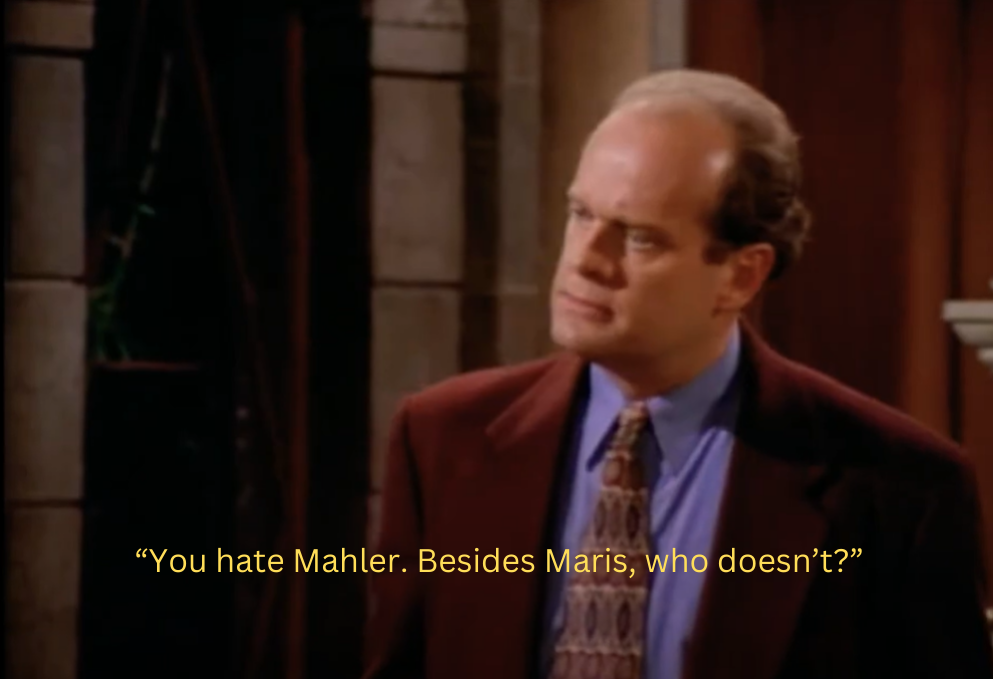
Herr Mahler, I adore your fourth symphony, most of your sixth and parts of your fifth. But your continuous refusal to cut down your works to human proportions means you will always be no more than a ‘composer who has his moments’ to me.

Also, adding more exotic instruments to a symphony adds novelty value, not substance. The chance I will ever listen to your fabled ‘symphony of a thousand’ is no higher than 0.1 percent.

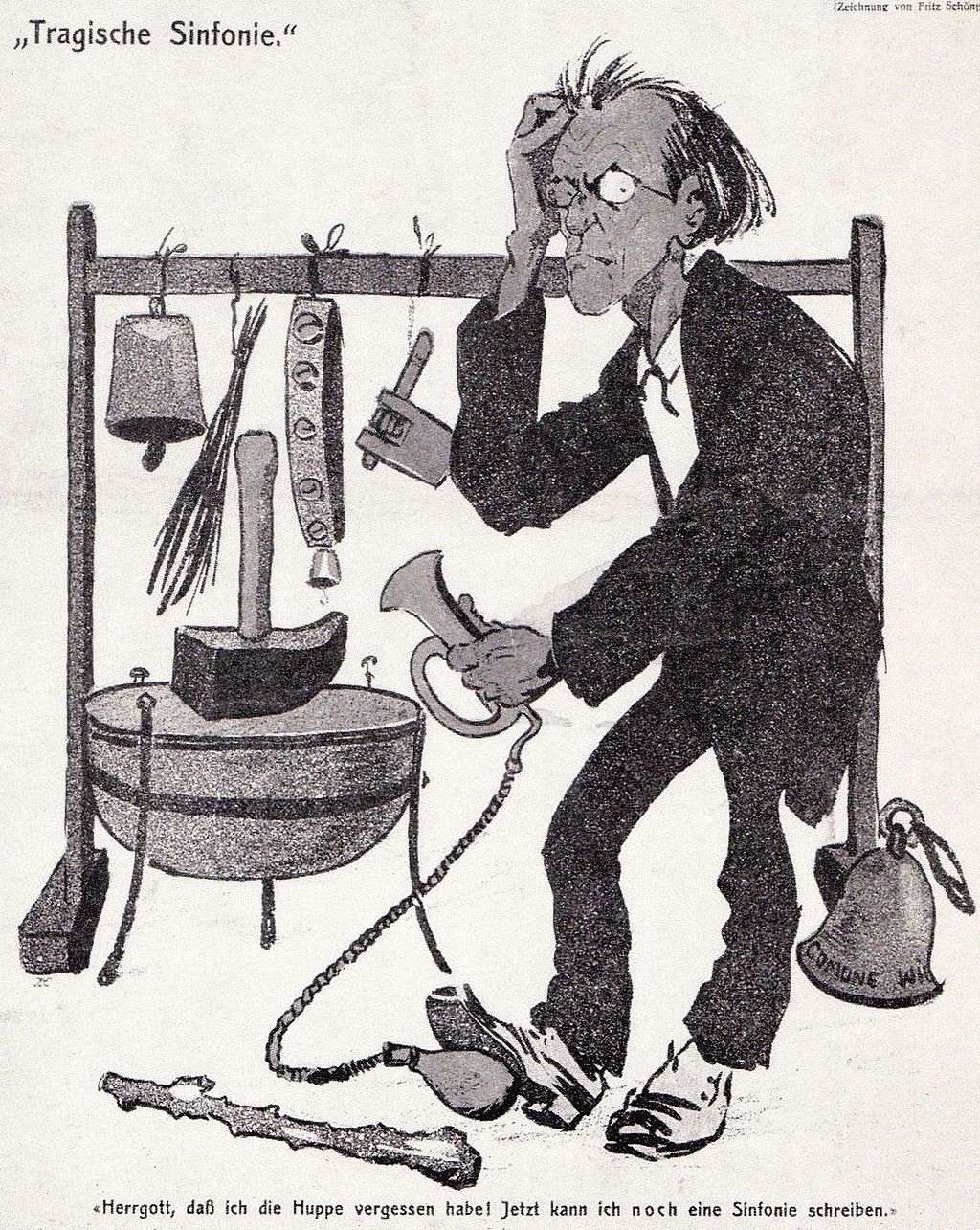
Mahler instruments
“Dear Lord, how could I forget the motor horn! Now I have to write another symphony.”

Finally, what also doesn’t alleviate my boredom or back pain while listening to your output is the philosophical guidebook that comes with it. Why burden your audience with your perennial woes about life and death? Just tell it to your shrink.

Frasier hates Mahler
Although probably not this one.

Classical music’s obsession with length and size

All right, maybe I just wasn’t in the mood that night. And perhaps I should have acquainted myself with the work before going to a concert.

Nevertheless, I can’t imagine I’m the only one with mixed feelings about these monstrous compositions that make up a big chunk of the classical repertoire – massive ideas that can only be expressed through colossal orchestras that go on endlessly.

That’s partly because our listening habits have changed over the last century. A live oversized symphonic orchestra must have made an overwhelming impression on ears unprepared for anything larger than a small ensemble.

We, on the other hand, are so accustomed to the most exotic of sounds directly entering our ear canals at all volumes and all times of the day that some wonder if we’re not already too deaf to enjoy non-amplified music properly.

Similarly, our on-the-go listening behavior doesn’t prepare us for concentrating on a piece of music for longer than five minutes, let alone for more than an hour.

However, we shouldn’t be too hard on our MTV/TikTok brains (depending on which generation you identify with). Consuming the ‘masterworks’ in easily digestible chunks was common throughout history. The idea that isolating a pretty adagio from an overall dull string quartet is as uncivilized as licking the frosting from a carrot cake is an invention as recent as the late 19th century.

Carrot cake
More recent, in fact, than the invention of carrot cake.

The unlimited musical resources behind Turangalîla

All this is to say that I hesitated to listen to Olivier Messiaen’s Turangalîla-Symphonie for a long time, despite its reputation as one of the 20th century’s musical masterpieces.

It was commissioned by conductor Serge Koussevitzky shortly after the Second World War. Koussevitzky explicitly said there were no limits on the length or the number of instruments.

Messiaen eagerly complied by writing a work of eighty minutes for an orchestra that includes – on top of the standard strings, woodwinds and brass – a percussion section of a vibraphone, glockenspiel, triangle, temple blocks, wood block, cymbals, tam-tam, tambourine, maracas, snare drum, tabor, bass drum, tubular bells and celesta.

The last empty corner of the stage is filled with a solo piano and an Ondes Martenot. This early electronic instrument makes the fweet sound like a radio dial going through different frequencies. That’s how Maurice Martenot came up with the idea during the war.

Incidentally, young Jonny Greenwood was a fan of the Turangalîla-Symphonie, which is why the Ondes Martenot pops up in many Radiohead songs.

A toy symphony for grown-ups

As expected, that big sound comes with big ideas. The Turangalîla-Symphonie is inspired by Tristan and Isolde and deals with romantic love and death – you can’t go much bigger than that. The name comes from two Sanskrit words:

  • Turaṅga means time that flows and refers to movement and rhythm.
  • Līlā means play of life and death, and of love.

All this – especially the Tristan and Isolde part – immediately brings the aforementioned 19th-century romanticism to mind.

But while Turangalîla displays the same level of excess, it holds back on the pomposity. This is an entirely different sound world from that of Wagner or Mahler. While the latter can display some ironic, even wry, humor, he’s never what you would call playful. And that’s precisely how I would describe Messiaen’s Turangalîla.

Because of the peculiar instrumentation and Messiaen’s tendency to mix styles, the work sounds like a toy symphony for grown-ups. You’re transported from dissonant passages over fevered, irregular dances to sweet Hollywood-esque chords. And everything’s pervaded by a light, jingly sound that informs you that nothing, not even excruciating beauty (and Turangalîla has that in spades), must ever be taken too seriously.

The man and the music

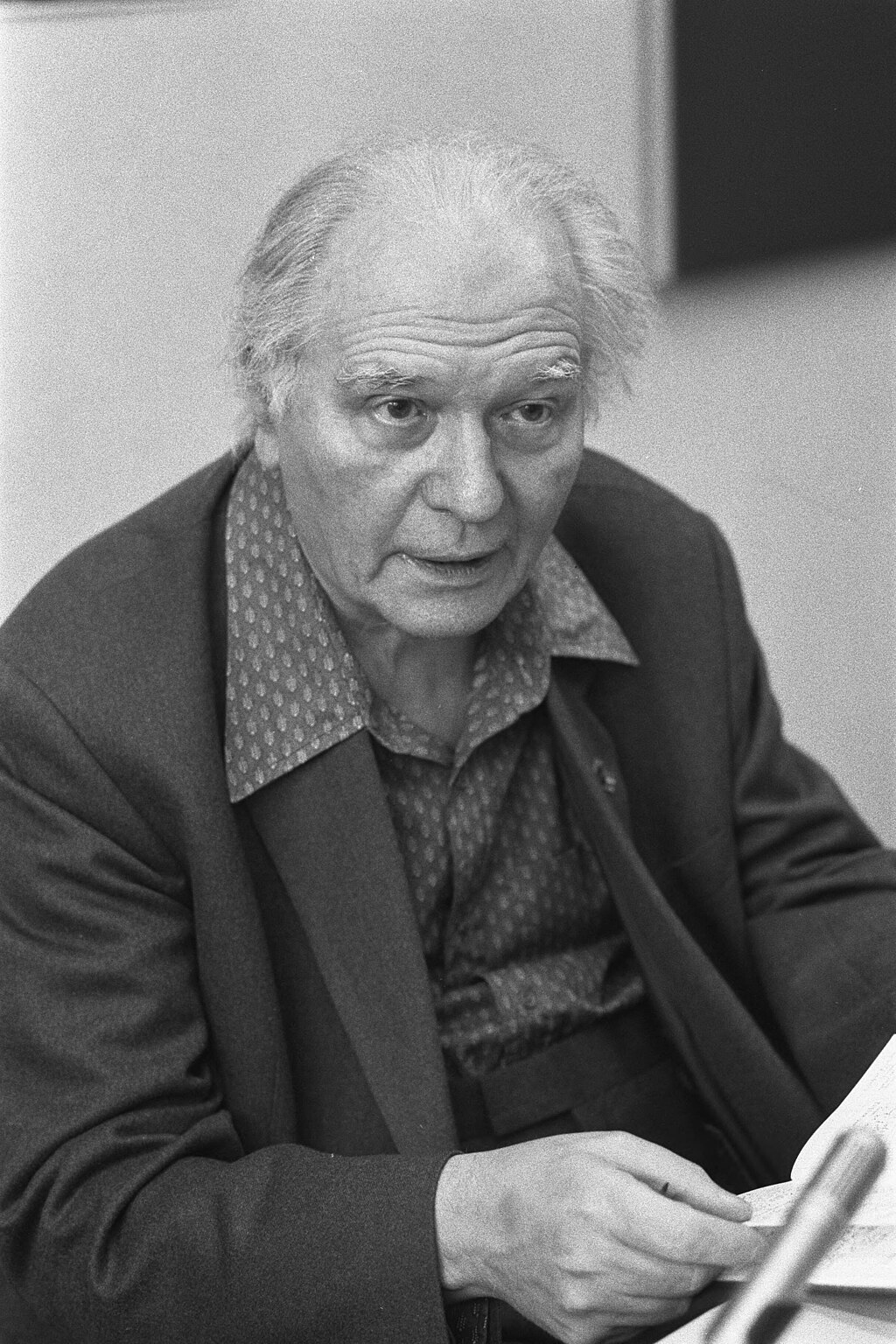
Maybe the composer’s personality has something to do with it. Olivier Messiaen (1908-1992) is portrayed by those who knew him as an almost comically good-natured man. Despite spending two years as a prisoner of war during the Second World War, he seems to have been free from existential torments.

A devout yet tolerant catholic and passionate ornithologist, he looked at the world with a mixture of old-man wisdom and child-like curiosity. This quote nicely sums up his outlook on life:

“I am convinced that joy exists, convinced that the invisible exists more than the visible, and that joy is beyond sorrow, and beauty is beyond horror.”
Olivier Messiaen, source

Messiaen Turangalîla

Although respectful of the man, avant-gardists such as Pierre Boulez despised Messiaen’s “sentimental” streak when it seeped into music – as it does profusely in Turangalîla.

That doesn’t mean Messiaen’s music is always easy on the ears. His melodies and harmonies touch familiar ground. But his rhythms are often very complex. Influenced by the tala structures of Indian classical music, he avoids regular meters. Instead, he likes to string together rhythmic cells of different lengths – which can be disorienting.

All in all, I would describe his music, in a musicological wholly unsound way, as frisky Stravinsky.

Two Turangalîla highlights to listen to

Turangalîla is an exuberant ode to life and love that I enjoyed more than I expected. Nevertheless, I couldn’t listen to it for more than 20 minutes. Not because it’s boring (mostly), but because it’s just too much. Too much noise, too many instruments, too many style changes. In short, at the risk of sounding like a complete oaf, too many notes – at least to be born for 80 consecutive minutes.

I therefore urge you to shamelessly lick some frosting from the carrot cake. Start with the two final movements, for example.

Turangalîla 3 is a set of variations that starts modestly with woodwinds and percussion. Gradually, the whole orchestra joins in, to which you can devote all your attention because the melody remains unchanged. Moreover, this happens to be a movement that uncharacteristically sticks to a regular 4/4 meter. It’s the perfect introduction to this remarkable sonic universe.

You’re then properly warmed up for the madness of Turangalîla’s Final, which starts like a drunken mariachi band and only further spins out of control. The rhythmic drive is characteristically irregular but also irresistible.

Around the fifth minute, you get a short moment to breathe, with extended treacly chords in the strings and the Ondes Martenot soaring high above it. Then, the whole thing climaxes with some more organized chaos and an extremely noisy final chord.

As you pick yourself up from the ground, you might agree that a little bit of Turangalîla goes a long way. But if you’re hungry for more, there’s another hour to set your teeth in. Bon appétit!

Richard Wagner’s Die Walküre

As every classical music lover must do at least once in their life, I’m attending Wagner’s complete Ring over two years. Because one does not simply walk into a world of gods, giants, dwarfs, dragons, and incestuous relationships, I’ll do my homework before every installment – and share it here. Part 2: Die Walküre.

At the end of Das Rheingold, we say goodbye to Wagner’s mythical world with a view of the gods stately entering Walhalla. In stark contrast, Die Walküre opens with a humble house in the forest. Restless cellos and double basses announce that a storm, and trouble, is brewing.

If you were dying to find out how Wotan, Fafner, or even Alberich were doing, you must be patient. The first character we meet in Die Walküre is no god, giant or dwarf, but a measly man named Siegmund. He’s looking for refuge from his enemies.

Act 1: the Volsung twins

Siegmund is found by Sieglinde, who’s waiting for her abusive husband, Hunding, to come back from the hunt. Taking pity on the stranger, she offers him some water.

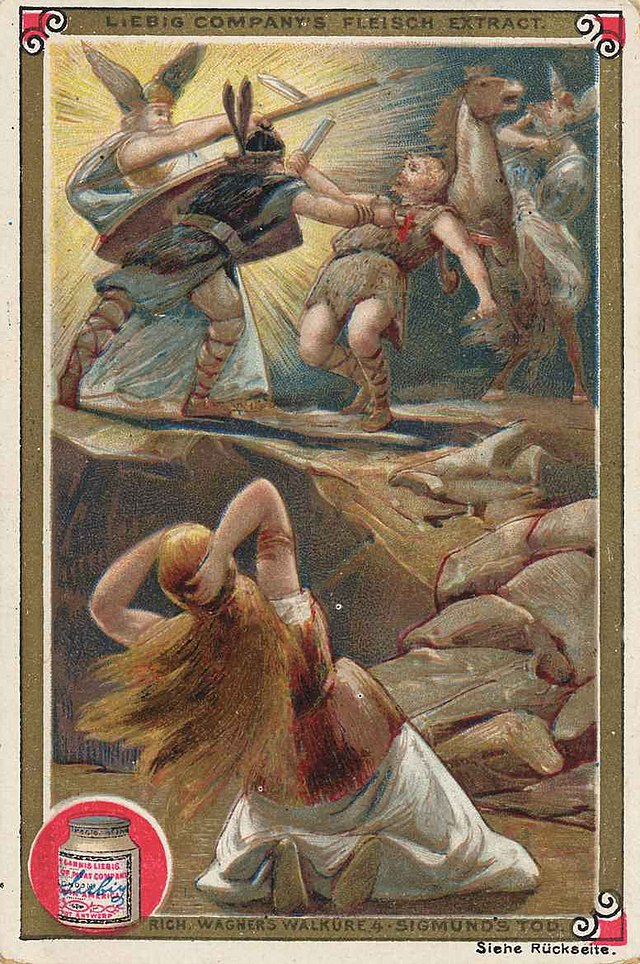
Siegmund Die Walküre
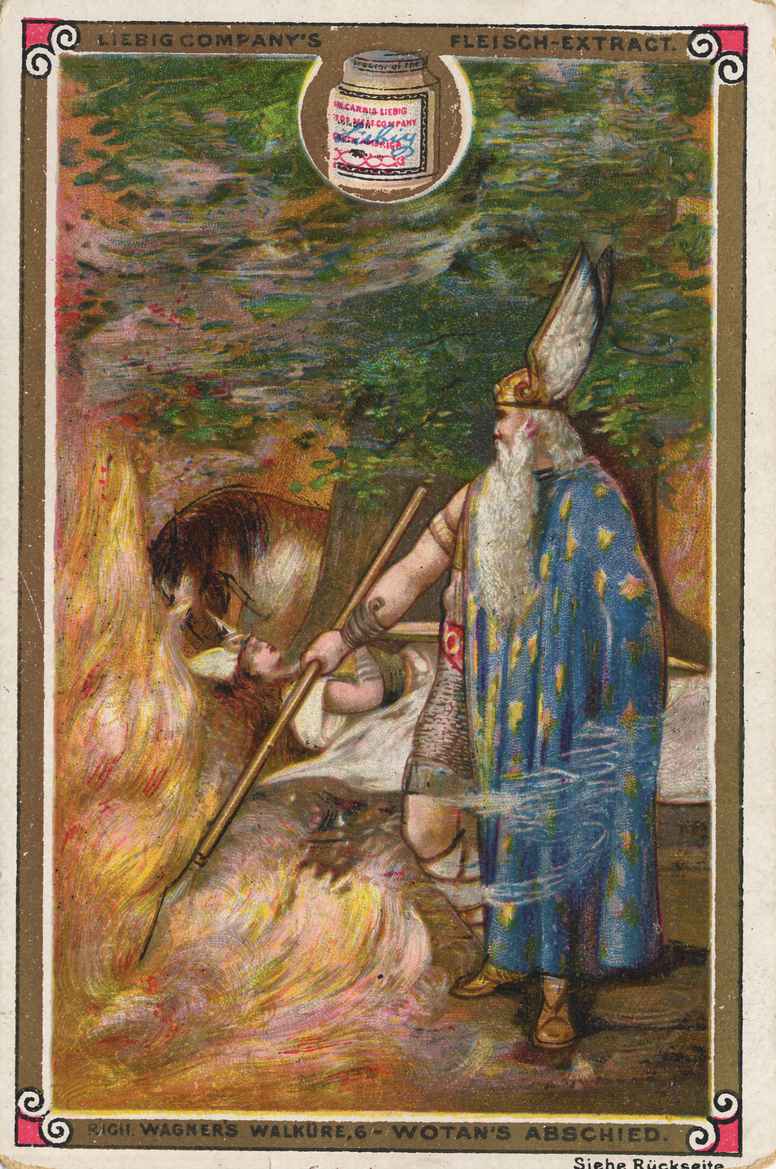
As depicted in this print from 1889, which came with a bottle of meat broth. Imagine children nagging their parents into buying more broth so they can complete their Walküre collection – then fruitlessly try to convince me this is the best time to be alive.

Hero or not, Siegmund comes over as a bit of a sourpuss. He won’t say his name but calls himself ‘Woeful’ – a ‘born loser,’ as the kids would say – and entertains Sieglinde with an account of his many misfortunes.

Sieglinde immediately sympathizes with this sadsack. When hubby Hunding enters the house, he’s understandably suspicious. He asks Siegmund about his past, who says he’s a ‘Volsung’ whose mother was killed by ‘Neidings’ who kidnapped his twin sister. Later, he was also separated from his father, Wälse (listen for the Walhalla music in the orchestra for a tip into who this is). Right before he fled to Hunding’s hut, he killed some Neidings in a fight.

Unfortunately, Hunding happens to be a Neiding. Not wanting to be inhospitable, he offers Siegmund a bed for the night. But breakfast will be a round of mortal combat.

After Hunding and Sieglinde go to bed, Siegmund wallows some more in his self-pity. Then, Sieglinde returns to tell him that an old man visited her house a while ago. He buried a sword in a tree, from where only a true hero can extract it. She’s convinced that Siegmund is this hero.

Suddenly, the doors open, revealing a beautiful spring after a harsh winter. Flowers bloom, birds sing, and Siegmund and Sieglinde realize they are brother and sister. Siegmund draws the sword from the tree, they sing a beautiful duet, and have great sex.

Siegmund and Sieglinde
Where meat broth reigns, there are no sins of the flesh.

Wait, what?!

That’s right: an incestuous relationship is at the heart of Die Walküre and the whole Ring cycle. If you listen closely during this scene, you hear the melody accompanying Alberich’s renunciation of love in scene 1 of Das Rheingold. What we see with Siegmund and Sieglinde is nothing less than the rebirth of love.

Of course, incest is a common ingredient of the old myths and legends that were Wagner’s source material. What’s shocking about Siegmund and Sieglinde is not their incestuous relationship but the way Wagner refuses to condemn it and even revels in it. The end of Act 1 is a precursor to the big finish of Tristan und Isolde: a musical depiction of intercourse – the female orgasm in particular. It’s as if the Lannister twins were the true heroes of Game of Thrones, and we were treated to countless scenes of their explicit yet tender lovemaking.

Act 2: meet Brünnhilde

After this strange and sordid miniature opera, the beginning of Act II feels like stepping onto firmer ground. We hear the Valkyrie theme for the first time in the Ring but for the hundredth-or-so time in our lives.

Moreover, we meet an old acquaintance: Wotan, king of the gods. He’s instructing his daughter Brünnhilde – a Valkyrie whose usual job description is to escort fallen heroes to Walhalla – to assist Siegmund during his upcoming fight with Hunding.

Brünnhilde expresses her gung-ho attitude with a “Hojotoho Heiaha!” Then she makes herself scarce because she sees Fricka approaching in her ram-drawn chariot – and her stepmother is not exactly in a good mood.

Fricka Wotan Die Walküre
You might say she ‘has a beef’ with Wotan.

As the divine protector of marriage, Fricka is understandably vexed by the brother-and-sister hanky-panky under Hunding’s roof. She condemns Wotan for tolerating this transgression of his own laws. And casually reminds him – not for the first time, one imagines – of his philandering over the years.

Wotan has been a busy boy indeed since Das Rheingold, conceiving:

  • The Volsung twins with a mortal woman
  • Brünnhilde with Erda, the earth goddess whom we briefly met during Das Rheingold
  • The other eight Valkyries with other mortal women

Demanding justice for Hunding (and for herself), Fricka insists that Wotan remove his protection of (his son) Siegmund. In reply, Wotan explains his plan: he sired Siegmund as a man of free will to steal the ring from Fafner before Alberich could get his greedy little hands on it. After all, he can’t do it himself because then he would (again) violate his own laws.

It sounds like a flimsy excuse for tomcatting around, and that’s precisely how Fricka takes it. Moreover, she points to the apparent hole in Wotan’s logic: if he helps Siegmund, the latter is no longer solely acting according to his free will.

Wotan gives in to his wife. When Brünnhilde returns, he orders her not to help Siegmund in his battle with Hunding. He also confides in her by telling her about all that’s happened during and after Das Rheingold. Now that his plan is failing, he bemoans his fate – “Alas, I only sire servants” – and predicts a doomed future for the gods.

Wotan leaves Brünnhilde alone, and then Siegmund and Sieglinde turn up. Sieglinde goes into a lot of unnecessary details on how good the sex with her brother was. At the same time, she’s ashamed because she was ‘tainted’ by Hunding before and is therefore not worthy to sleep with Siegmund.

This might be where you conclude you’re fed up with this nonsense. Every sane person has that feeling at least once during any Wagner opera. But that’s when it typically happens: a moment so heartbreakingly beautiful and simply human that you cannot fathom how it could have been written by the same person who moments ago served you that pseudophilosophical drivel.

I’m talking about the scene popularly known as the ‘Todesverkündigung.’ Brünnhilde informs Siegmund that he won’t survive the battle with Hunding. But this cloud has a silver lining: she will take him to Walhalla, where he will live the life of a prince, meet his father, and enjoy the company of countless ‘wish-maidens.’

All good and well, says Siegmund, but if Sieglinde is not there, I’ll pass.

This simple declaration of love is set to some of the most moving music ever conceived. No need for anvils or other shenanigans to wow the audience here, just some low wind instruments like trombones to paint a solemn and haunting atmosphere.

Then, Siegmund says he’d rather kill his wife than die without her, which is weird again. But it does convince Brünnhilde to defy Wotan’s order.

Now it’s time for the big action scene! When Hunding shows up, the duel ensues. First, Brünnhilde intervenes to help Siegmund, but then it’s time for the true deus ex machina. Wotan shatters Siegmund’s sword, so Hunding can deliver the fatal blow.

Siegmund dies Die Walküre
Felled like an ox!

Hunding is not allowed to enjoy his triumph for long. Wotan orders him to tell Fricka the ‘good news,’ strikes him down, and resolves to have his revenge on his disobedient daughter Brünnhilde.

Die Walküre, Wagner and Women

This is how you likely picture Brünnhilde:

Lillian Nordica Die Walküre

It’s a photo of Lillian Nordica, a famous American soprano who, as a suffragette, also used her voice to loudly call for women’s right to vote. It’s a cause that Wagner wouldn’t have approved of. It won’t surprise you that he wasn’t – even by the standards of his time – a feminist.

And yet, as Alex Ross explains in his book Wagnerism, many proponents for women’s rights were inspired by Wagner’s works – and Die Walküre in particular. While the men – Wotan and Siegmund – constantly whine about how powerless they are, the women take action and change the course of events.

Without getting ahead of ourselves too much, it’s undoubtedly Brünnhilde who’s the true hero(ine) of the complete ring cycle. And so it’s only fitting that the most popular installment of the four is named after her. And that she gets the most bitchin’ theme music before Darth Vader.

For now, though, she won’t be rewarded for her bravery.

Act 3: Wotan’s punishment

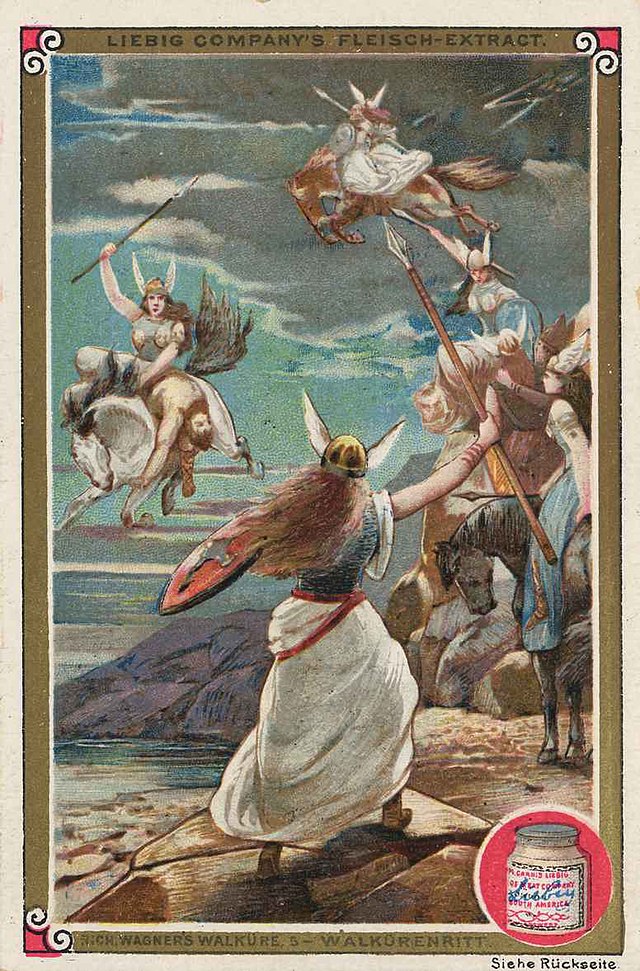
Is that napalm you smell? Do you hear the helicopters whirring? Yes, the third act opens with the famous Ride of the Valkyries. They come galloping home from their job as battlefield cleaning ladies, taking away the fallen heroes.

Ride of the Valkyries Die Walküre
Fresh meat for Walhalla!

One carries a different cargo: Brünnhilde whisked Sieglinde away from the crime scene and hopes to hide her from Wotan. At first, Sieglinde – in true romantic fashion – insists that she’d rather die than face a future without her brother/lover. But when Brünnhilde informs her that she’s carrying Siegmund’s child, she quickly changes her tune.

Brünnhilde hopes for some sisterly solidarity in the wake of a wrathful Wotan. But Gerhilde, Helmwige, Ortlinde, Waltraute, Rossweise, Siegrune, Grimgerde and Schwertleite go into instant panic mode. Luckily, their exquisite ensemble singing more than makes up for their cowardness.

Brünnhilde tells Sieglinde to flee to the eastern forest where Fafner, now transformed into a dragon, sits on his hoard – and Wotan would not dare to go. She also gives Sieglinde the fragments of Siegmund’s sword. Her child, Siegfried, will one day forge it again.

Brünnhilde faces Wotan alone. The disappointed father refuses to listen to her pleas for mercy and comes up with a cruel punishment: she will be put to sleep and at the mercy of the first man who wakes her.

After some more protests by Brünnhilde – “Anything is better than marrying a worthless man” – he agrees to circle her body with a ring of fire. Only a true hero can get to her, and it’s obvious who she has in mind for that role. In true operatic fashion, Wotan says goodbye to Brünnhilde 57 times, calls on Loge to start a nice blaze, and so ends Die Walküre.

Wotan Brünnhilde Die Walküre
But we will ‘meat’ again!

Are these the best classical tracks of 2023?

Probably not. But out of the ones I’ve heard, I’ve enjoyed these the most.

Listen to the Spotify playlist

10. Le tableau de l’opération de la taille (Marin Marais)

Marin Marais alb

Featured on: Marin Marais: Folies d’Espagne, La Rêveuse & other works (Jean-Guihen Queyras & Alexandre Tharaud)

Admittedly, this first entry is something of a ‘novelty song.’ It’s included on a record that has a lot more beauty to offer. Jean-Guihen Queyras & Alexandre Tharaud interpret viola da gamba pieces by Marin Marais (1656 – 1728) for cello and piano, with stunning results. You should check it out in full.

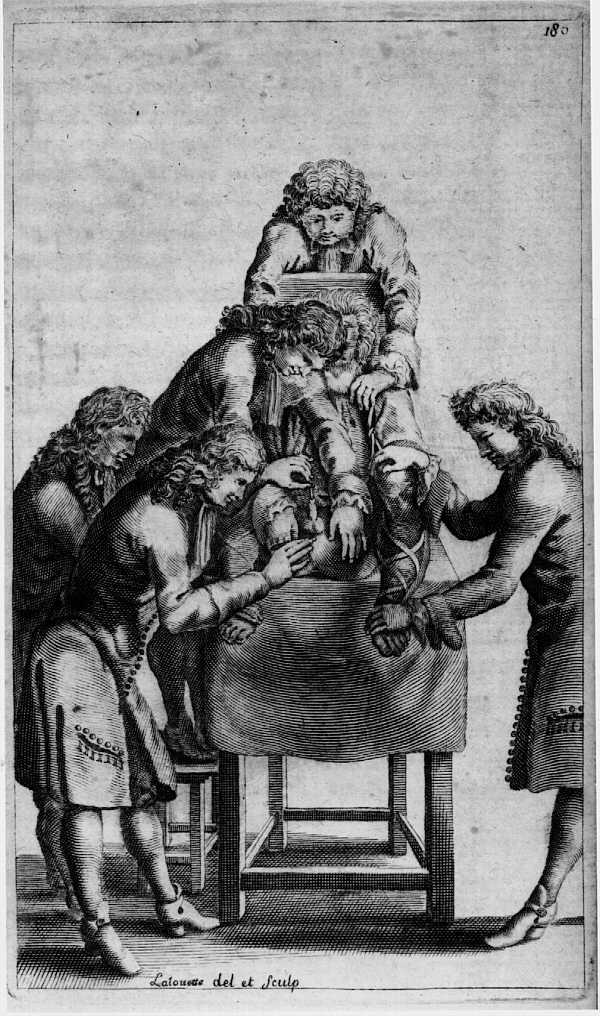
On this track, actor Guillaume Gallienne joins them to recite the text that Marais added to his piece Le tableau de l’opération de la taille. ‘La taille’ is the removal of a bladder stone, a horror Marais himself had to undergo when he was about 64.

Marin Marais opération de la taille
These people are smiling way too much.

Marais decided to pour his painful experience into a song. Much like Taylor Swift in Death by a Thousand Cuts, but with actual pain.

The text details the procedure. If you don’t understand French, consider yourself lucky. The music expresses the feelings of the patient. At the crucial/most excruciating moment, Marais decides the traditional Baroque style cannot capture the mood and skips ahead to early-twentieth-century expressionism. Who can blame him?

9. We played some open chords and rejoiced, for the earth had circled the sun yet another year (Dustin O’Halloran)

Echoes orchestra of the swan

Featured on: Echoes (Orchestra of the Swan)

Midlifers like me remember the concept of ‘mix tapes’: a carefully selected collection of songs that fit on a 60-or 90-minute cassette tape. The idea was that such a highly personal selection would reveal to the recipient, usually a love interest, how sophisticated we were – without the hassle of actually having to express a feeling or a thought. Unsurprisingly, that never worked. Not once.

Mix tape
Newsflash: Sophie erased your assortment of Morrissey and Nick Drake songs to make a ‘serious beats’ compilation for a guy named Chuck.

Orchestra of the Swan uses the mix tape concept to present a range of compositions that have no apparent reason to be on the same record: from Bach and Glass to Portishead and The Velvet Underground. If there’s an overarching message in all this, I couldn’t find it. It’s just a varied, enjoyable listen; sometimes, that’s all you want.

The track that stands out most is this minimalist piece, originally by the ambient duo A Winged Victory for the Sullen. The backbone of the composition consists, true to the title, of only a few open chords. They’re surrounded by flutters in the violins and some well-timed sighs of the cello.

Remove or add a few notes, and this would become the kind of music they generously disperse through your local wellness center. As it is, it sounds equally relaxing and moving. Halfway through, there’s a delightful Schubertian shift in the harmonies – always good for extra points in my book.

8. Fuga – allegro con spirito from piano sonata in e-flat minor, Op. 26, (Samuel Barber)

Barber piano sonata

Nobody could accuse Samuel Barber of taking the easy road when he started his piano sonata. It’s a composition that summarizes at least two centuries of keyboard music, with nods to Bach, Beethoven, Schoenberg and Gershwin.

It’s all the more impressive that the piece presents a unified whole where the seams never show. This final movement combines a classical fugue with jazzy inflections, twelve-tone rows and some Debussy-esque orientalism – ending with a humorous twist that would have pleased Papa Haydn.

Speaking of whom:

7. Adagio from Symphony nr. 31 (Joseph Haydn)

Haydn symphony 31

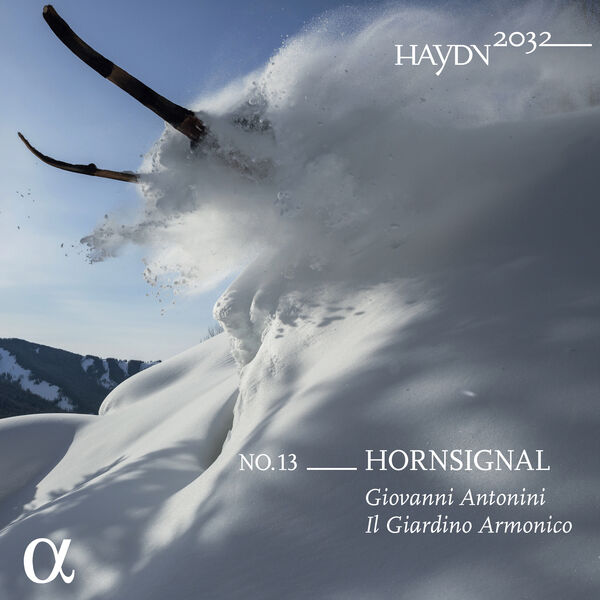
Featured on: Haydn 2032, Vol. 13: Horn Signal (Il Giardiono Armonico – Giovanni Antonini)

Giovanni Antonini and Il Giardino Armonico got it into their heads to record all 106 Haydn symphonies by 2032. Each – beautifully packaged – volume presents a few works under some common theme. On volume 13, it’s the presence of a prominent section of no less than four horns.

This early adagio in a gently rocking siciliano rhythm is far removed from the monumental ‘London symphonies’ of the older master. Haydn wasn’t yet speaking to the world but trying to please his master by catering to the strengths of the members of his ensemble. Each gets his turn to shine, with a special role for the horns, of course. But the young(ish) ‘master of form’ already knows how to unite it all into one balanced and engaging whole.

6. Tarentelle, pour flûte, clarinette et orchestre, op. 6 (Camille Saint-Saëns)

Bacchanale saint-saens

Featured on: Bacchanale: Saint-Saëns et la Méditerranée (Zahia Ziouani)

Camille Saint-Saëns visited Algeria no less than eighteen times. There, he picked up some tunes to include in several ‘oriental’ compositions.

These days, such compositional curiosity could lead to accusations of cultural appropriation. And you can’t deny that in those heydays of French colonialism, the musical exchange didn’t exactly happen on equal terms. So it’s nice that on this record, Zahia Ziouani combines the orientalism of Saint-Saens with contemporary Arabic songs.

The track I’ve chosen is an airy tarantella – Italian rather than oriental and with some Viennese flavors in the middle part. The flute and clarinet tumble acrobatically over each other, with other instruments sporadically joining in. It’s an impressive demonstration of Saint-Saëns’ compositional skill and keen talent for orchestration.

5. Solstice In/Solstice Out (Anna Meredith)

Nuc Anna Meredith

Featured on: Nuc (Ligeti Quartet – Anna Meredith)

Two tracks for the price of one, because they’re as indivisible as yin and yang. Solstice In drives up your blood pressure through a string quartet that moves from agitated glissandi to dull and obsessive pizzicati, combined with a piercing trumpet. Solstice Out brings you down again when both strings and trumpet are muffled and hesitant. It’s kind of like a musical hot-and-cold bath to both jolt and soothe your nerves.

4. Dans mon jardin à l’ombre (Anonymous)

Mon amant de saint-jean

Featured on: Mon amant de Saint-Jean (Stéphanie d’Oustrac – Le Poème Harmonique)

In 2023, I raved about an album by Joel Fredriksen that artfully combines Leonard Cohen’s songs with Renaissance chansons. One of those songs could have easily made this list. But I decided to include something from another album with a similar approach. It serves a fricassee of 17th-century popular songs, 17th-century Italian opera, and 20th-century popular songs – though never within the same tracks.

Thanks to a distinctive accordion and d’Oustrac’s impressive and theatrical delivery, this album sounds so French that it should come with a complimentary baguette. This track is a dark tale about a woman turning down a handsome young soldier because she’s married to a jealous, even violent older man. Musically, it would pair remarkably well with Cohen’s The Partisan.

3. Ah ch’infelice sempre (Antonio Vivaldi)

Sacroprofano

Featured on: Sacroprofano (Tim Mead – Arcangelo – Jonathan Cohen)

There are still those who look down on Vivaldi because he was ‘formulaic.’ They’re wrong for two reasons. First, every Baroque composer was formulaic by later standards. Yes, even J.S. Bach. Two, listen to an aria like this one and tell me with a straight face that this would be out of place in the St Matthew Passion.

The lyrics would have to be adapted, as this aria recounts the peculiarly frustrating sensation of being rejected by a nymph. Much like Cold As You by Taylor Swift, but with a minor divinity from antiquity instead of an emotionally unavailable dude from the Nillies.

Plucked strings express the falling tears in the A and A’ sections. The ending of the contrasting B section is lovely: one note hangs like an unfinished thought when the A’ section unexpectedly kicks in. It demonstrates that no formula is ever exhausted in the hands of a genius.

2. Ich will schweigen (Johann Hermann Schein)

Ein deutsches barockrequiem

Featured on: Ein Deutsches Barockrequiem (Vox Luminis – Lionel Meunier)

In 2023, the wealthiest man in the world conclusively revealed himself to be a narcissistic and delusional cartoon villain. As if that fact wasn’t scary enough, a surprising number of people are happy to condone his behavior because he’s a genius – just like Beethoven, J.S. Bach and Taylor Swift. ‘Genius’ is a label that we apply very quickly. I did it three sentences ago. And it’s not without its risks, like inflating the contribution of a few while underestimating those of the many.

Although Johann Hermann Schein is dutifully mentioned in all books on baroque music, no one would ever call him a genius.

Johann Hermann Schein
Although he had the hair of a genius. A MAD genius!

And yet, he composed what I consider to be one of the greatest masterpieces of the era. At least since I first heard it two years ago. It’s now recorded by my favorite baroque ensemble and, thus, an immediate certainty for this list. The text is a typical example of the long-lost virtue of humility, even slipping into the less commendable self-humiliation before the eyes of the Lord.

It ends with the sentence, ‘Ach wie gar nichts sind doch alle Menschen!’ – Oh, how all people are really nothing. Schein’s triumphant setting is paradoxical but fitting. Because what thought could be more liberating, both in the 17th century and today?

Elon Musk
Pictured: nothing

1. Maestoso from piano concerto nr. 1 in d minor (Johannes Brahms)

Brahms first piano concerto

Featured on: Brahms: Piano Concertos (Simon Trpčeski – Cristian Măcelaru – WDR Sinfonieorchester)

I earlier outed myself as middle-aged. Though that has been mathematically correct for quite some years, I’ve only truly felt it in 2023.

One of the great things about growing older is that you’re less likely to be taken on a rollercoaster by your emotions. But it unfortunately also means that music doesn’t ‘come in’ as powerfully as it used to.

Gone are the days when I could put on Beethoven’s Seventh or Schubert’s Unfinished at any time of the day and immediately enjoy the feeling of having access to all the sorrow and joy entangled with human existence. These days, I’m just as likely to mellow out to a Haydn adagio. Nice, but not quite the same.

But I’m also not that old yet. And I particularly feel that when I’m exploring the works of the young Johannes Brahms. His first piano concerto was finished shortly after the suicide of Robert Schumann – his friend, mentor, and husband of the love of his life. They say the opening chords picture that fateful leap into the Rhine. It doesn’t get much more adolescently pathetic than that. And I mean that in the best possible sense.

The concerto is not virtuosic but challenging to play, which is the exact opposite of what you would want as a soloist. The orchestration is also not particularly brilliant, as Brahms was still refining that part of his craft. Its first performances were not well received. Today, it’s respected, of course, but not nearly as popular as, say, Beethoven’s 3-4-5, Tsjaikovsky 1, or Rachmaninov 2.

None of that matters when you listen to this fantastic recording. The chemistry between the soloist and orchestra is out of this world, as is the sound quality. It never failed to entrance me, remind me what got me into classical music in the first place, and even make me feel twenty again!

And if you’ll now excuse me, I must get New Year’s dinner going. I won’t sleep a wink if I eat after 8 p.m.

Richard Wagner’s Das Rheingold

As every classical music lover must at least once in their life, I will attend Wagner’s complete Ring over the next two years. Because one does not simply walk into a world of gods, giants, dwarfs, dragons and incestuous relationships, I’ll do my homework before every installment – and share it here. Starting with: Das Rheingold.

Wagner’s collection of four operas, Der Ring des Nibelungen, is essentially the earliest example of the modern fantasy genre. Without it, there would probably be no Lord of the Rings, Star Wars, or Game of Thrones.

That reference to blockbuster movies and TV shows may help lessen the concerns of those about to embark on fifteen hours of German opera. But it also runs the risk of creating false expectations.

Disappointingly, the Ring doesn’t contain massive assaults on medieval strongholds or titillating whorehouse scenes.

Richa
Although some album covers might suggest otherwise.

There may be some impressive stagecraft involved. And the music can be as deliciously pompous as the best Hollywood has to offer. But most of the time, you’ll be watching a handful of people elaborately singing about their convoluted feelings.

Are you worried again? The good news is that you can gently roll into it all with Das Rheingold, the opera that packs the most action of the four Ring installments, in the tiny duration of two and a half hours. However, be aware that there probably won’t be an interval, as there are no breaks in the music between the four scenes.

An accessible appetizer to the Ring’s main courses

Das Rheingold is also the Ring opera that’s easiest to understand. In its entirety, Der Ring des Nibelungen is an incoherent mess. Nietzsche speculated that Wagner deliberately obfuscated the story because he feared it was too simplistic. There is, however, a less malicious explanation for the Ring’s maddening inconsistencies. From the time Wagner wrote the original story until the moment he composed its last note, more than twenty-five years had passed. Twenty-five years in which Wagner transformed from an arrogant, antisemitic left-wing revolutionary/terrorist to an arrogant, antisemitic right-wing bootlicker of Europe’s craziest monarch. Naturally, the big messages he wanted to convey with his operas had also changed.

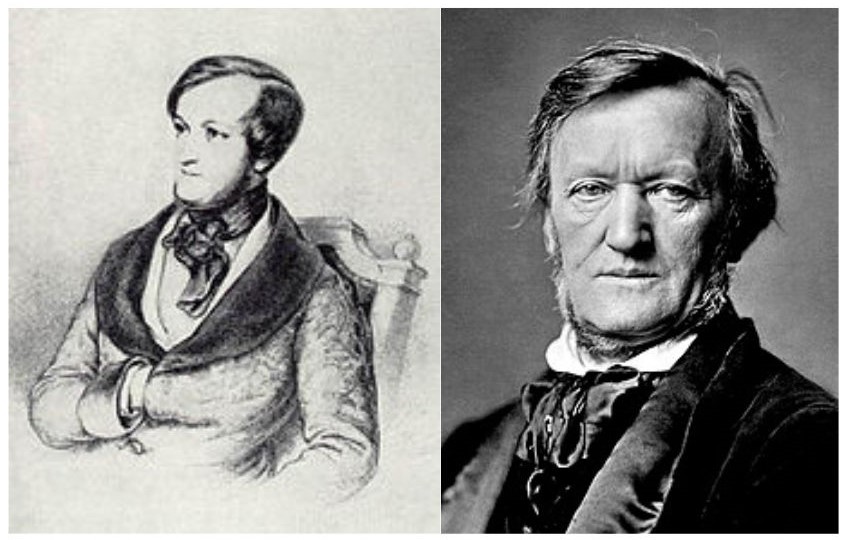
Young and old Richard Wagner
Richard Wagner in 1840 and 1871

Das Rheingold, composed in 1854, stays true to the Ring’s original concept. In 1848 – when revolutions engulfed Europe – Wagner cobbled together his ‘myth’ from various Scandinavian, German and Greek source materials. It’s meant to be a story that presents universal human themes. And we’ll see that it sometimes resonates eerily with the world we know today. But in essence, it’s a commentary on 19th-century society, particularly its inequalities.

Characters in Das Rheingold

Gods

As a lot of people know, the Ring is about gods. Wing-helmed, blonde-haired, sword-wielding gods. And you might think, knowing what everybody knows about Wagner, that these divine heroes are personifications of German superiority.

In reality, Wagner’s gods are a sad bunch. They’re the supposed leaders of their world. But their power doesn’t come from their spiritual, intellectual, or moral superiority. Instead, they use violence to get their way. More importantly, they make social rules that they then break themselves. They’re hypocritical, vain and corrupt. For Wagner, they represented the contemporary ‘enlightened’ monarchs and clergy.

In Das Rheingold, only Wotan (the ruler of the Gods), his wife Fricka, the half-god Loge and the earth goddess Erda are important characters. The others merely hang around to demonstrate their pointlessness.

Dwarves

Like in Lord of the Rings, Wagner’s dwarves are driven by material lust. Their home is Nibelheim, where they delve for gold in the earth’s bowels and have little interest in anything else. They’re also quite hideous to look at. For Wagner, they probably represented the 19th-century bourgeoisie.

In Das Rheingold, we meet the dwarf brothers Alberich and Mime.

Giants

Giants are big and stupid. They’re also hard workers. For Wagner, they probably represented the proletariat, although nobody seems to know for sure.

In Das Rheingold, we meet the giant brothers Fafner and Fasolt.

Rhine maidens

The Rhine maidens are water-nymphs that swim, sing and protect the Rhine gold for which the opera is named. They’re beautiful and haughty, two facts that will propel the story to its disastrous conclusion.

The story of Das Rheingold

The original sin

The iconic opening of Das Rheingold is Wagner’s musical evocation of the beginning of the world. It starts not with a bang but a whisper: a steadily expanding E flat major chord.

We then meet the three Rhine maidens frolicking in the water. Suddenly, they notice Alberich ogling them. The dwarf tries to seduce them, but they mock him for his hideous appearance.

In his rising frustration, Alberich sees the gold the Rhine maidens are meant to guard. They tell him that anyone who wins the gold and makes a ring out of it will become master of the world. But he would have to ‘forswear the delights of love.’

Richard Wagner Das Rheingold Rhine maidens

What then happens is Wagner’s version of the downfall. Against all expectations, Alberich, the world’s first incel, renounces love in exchange for power. He steals the gold, leaving the Rhine maidens panicked and grieved.

In this first scene, Wagner, the dramatic genius, introduces the opposition that defines the entire Ring: love versus power.

The misguided contract

We now meet the gods high up a mountain. There, Wotan built a fabulous castle named Walhalla – an ostentatious symbol of his power. That’s to say, the giants did the actual building. And Wotan is only now pondering how to reward them for it. Being a god, he entertains the silly illusion that he’s above mundane stuff, such as money.

He’s so silly that he drafted a contract with the giants: in the event of a cash flow problem, he would fulfill the payment in kind by giving away his sister-in-law Freia. You could argue that can be a small price, but in any case, Wotan’s wife Fricka – Freia’s sister – isn’t too happy with this arrangement. Neither are her brothers Donner (god of thunder) and Froh (god of spring).

The gods’ attachment to Freia is not only emotional. Her golden apples also ensure their eternal youth. So, her disappearance would mean a certain death for everyone on that hill.

What was Wotan thinking?

The answer is that he took the advice of Loge, the (half-)god of fire who joined the Gods for opportunistic reasons. He’s the smart guy in the Ring, but that doesn’t mean he’s wise. In fact, his guidance will lead to the gods’ downfall.

Loge promised Wotan he would find a way out of his promise to the giants, but he’s now nowhere to be seen. Meanwhile, the giants have arrived, demanding that Wotan keeps his word. Notice that Wagner’s music to characterize the giants is as deliciously unrefined, even clownish, as Fasolt and Fafner themselves.

Just in time, Loge joins the scene. He tells everyone the story of Alberich stealing the gold from the Rhine maidens. Surely the gods should be willing to steal it back and return it to the rightful owners? Most Gods agree, also because they feel the upstart dwarf could become a challenger for the power that they consider their birthright.

Wotan isn’t so sure. After all, stealing from a thief is still stealing – against his precious rules. Until Fasolt and Fafner mention that the Nibelung’s gold would be a fitting reward for their labor. Wotan feels a sudden compassion for the Rhine maidens and decides to go with Loge to Nibelheim to retrieve the gold.

In capitalist hell

The descent to Nibelheim is one of those scenic and musical transformations that Wagner excels at. As we leave the stately atmosphere of Walhalla behind, we’re greeted with a restless motif in the strings of the orchestra and the sound of hammering on eighteen anvils. Yes, literally eighteen anvils:

This is Wagner’s unforgettable evocation of the horrors of the industrial revolution. Alberich has become an entrepreneur and turned his home into a capitalist dreamland.

His fellow dwarves, including his brother Mime, are forced to work for him 24/7. Just when we come in, he’s fitting the Tarnhelm, a piece of high-tech headgear that can transform him into any shape or make him invisible. The explicit purpose is to spy on his workforce without himself being seen. All pretty visionary stuff.

Richard Wagner's Das Rheingold Nibelheim
Pictured: a typical Amazon warehouse

On meeting Wotan and Loge, Alberich boasts about his wealth and power. Soon, he will bend the world to his will, and the reign of the gods will be over. When the cunning Loge asks Alberich how he can prevent someone from stealing the ring, Alberich demonstrates the power of the Tarnhelm by transforming into a serpent.
Loge then asks Alberich if he can also turn into something tiny. What follows is comic book stuff. A moment later, Alberich is bound and dragged to the divine mountain top.

A curse and fratricide

Alberich comes up with a plan: give up his hoard of gold to the intruders but keep the ring, and then start again. But the plan fails. After the gold is transferred, Wotan demands that Alberich also give up the ring, forcefully taking it from him. Just before he is released, the dwarf curses the ring: all who have it will suffer, and all who don’t have it will want it.

It won’t take long before the curse starts to do its work. When Fasolt and Fafner arrive, they put the gold in a pile before Freia. Only when she’s entirely out of sight (Fasolt is genuinely in love with her) shall they be content.

Wouldn’t you know it, when all the gold is on the pile, exactly one ring-shaped whole remains through which one of Freia’s fair eyes can still be seen. The giants demand that Wotan give up the ring, which the god, already consumed by the ring’s power, refuses.

Then Erda, the earth goddess one step higher in the divine hierarchy than Wotan, shows up. She orders Wotan to give up the ring. But also casually mentions that the Gods will perish in any case, which is weird.

Anyway, Wotan decides to follow Erda’s advice. He hands the ring to the giants, who immediately start fighting over it. In a literal slapstick moment, Fafner kills Fasolt with his stick and walks away with the gold and the ring.

The gods decide the show’s over, and it’s time to settle into their mighty new fortress. Donner has his moment in the spotlights when he conjures up a thunderstorm, after which a rainbow bridge allows the gods to stride to Walhalla.

Richard Wagner's Das Rheingold Walhalla

While the other gods seem to think their power is secured now the ring is in the hands of the stupid Fafner rather than the cunning Alberich, Wotan is not so sure. But how can he retrieve the Ring without breaking his own precious laws?

Around that central dilemma, the next twelve hours of opera will revolve.

Erlkönig by Schubert: the four most haunting moments

A few weeks ago, I heard a radio interview with an acclaimed singer who was asked about her favorite works. The first on her list was Schubert’s Erlkönig – the song that cured her of her opinion that classical German piano lieder are – in her words – “girl/boy scout music.”

Such scandalously unsophisticated sentiments are rarely uttered on a classical radio station. I certainly raised an eyebrow. And I’m sure the other three listeners did as well.

But she wasn’t completely wrong. For me, Franz Schubert is the only true son of God who walked the earth for 30-ish years. But even I will never voluntarily listen to something like this:

It’s not bad, of course, just meh.

My mother played a lot of that stuff when I was ten years old – hogging the stereo that I clearly needed for my Duran Duran CDs. So it’s no wonder that I grew up with a healthy disdain for the whole lied genre.

For me as well, that changed because of one song that instantly blew me away: Erlkönig. It still does that, each time I listen to it.

Especially these three moments never fail to raise at least a few hairs on my arms …

1: The opening: ‘are you scared yet?’

Schubert’s Erlkönig is a setting of a poem with the same name by Goethe, itself based on a traditional Danish ballad called Elveskud. It’s a kind of horror miniature about a boy dying while in his father’s arms. The perpetrator is a fairy king and his alluring daughters, who are all only visible to the son.

Erlkönig Schubert

Schubert immediately cuts off your breath with these iconic opening measures:

Erlkönig Schubert manuscript
The notes are Schubert’s handwriting, the blue and red rectangles are made with cutting-edge 21st-century technology. Notice the pp (very soft) marking on the left, which a lot of interpreters discard.

Those octave triplets in the right hand (marked blue) are devilishly difficult to play, especially because you have to keep that up for most of the piece. Unless you do it at half the tempo, of course. The received wisdom is that it represents the galloping of the horse that speeds home with father and son. Its psychological effect is more important: literally hammering home a sense of panic and inescapable doom.

The motif in the left hand (marked red) – simply trotting up and skipping down a minor scale – completes the spooky atmosphere. The stage is all set for the entrance of the narrator, when Schubert inserts these two bars (0:18 in the video above):

Schubert Erlkönig manuscript

Face it, this is put in purely for its effect value. It’s not so much dictated by musical logic, but rather by the need to emphasize to the listener that this is going to be scary – no, really scary – stuff.

2. The true villain is revealed: ‘stop whining, silly child’

Erlkönig is a through-composed song, which means there are no strophes or refrains. One of the main tools Schubert uses to both differentiate the four characters – narrator, father, boy and Erlking – and give a clear direction to the story, is multiple key changes. Watch this excellent video analysis if you want all the details on that.

In the beginning, the narrator gives us the bare minimum of factual details we need to understand the story:

Wer reitet so spät durch Nacht und Wind?
Es ist der Vater mit seinem Kind;
Er hat den Knaben wohl in dem Arm,
Er faßt ihn sicher, er hält ihn warm.
Who rides, so late, through night and wind?
It is the father with his child.
He has the boy well in his arm,
He holds him safely, he keeps him warm.

This whole fragment stays more or less in the home key of G minor, even emphatically landing there on ‘warm’ (0:58 in the video above) Then the boy starts to express his worries in C minor, a key close to G minor:

Siehst, Vater, du den Erlkönig nicht?
Den Erlenkönig mit Kron’ und Schweif?
Father, do you not see the Erlking?
The Erlking with crown and cape?

The father casually dispels his concerns:

Mein Sohn, es ist ein Nebelstreif.My son, it is a streak of fog.

This is the second hair-raising moment on my list. It’s in B flat major – the first time the music veers to one of the ‘happy’ keys. It fits the idea of the father soothing the boy. To my ears, there’s also something ‘misty’ about the sound of that chord, which fits the text. But that could be just me.

In any case – as all listeners know – the father is dead wrong. Is he admirably comforting the boy? Or is he failing to take him seriously? And if the latter, is he perhaps complicit to the drama that’s about to unfold? Even the real villain of the story? Tellingly, when the Erlking next launches his charm offensive at the boy, it’s in the same key of B flat major (1:42 in the video above):

Du liebes Kind, komm, geh mit mir!
Gar schöne Spiele spiel’ ich mit dir;
Manch’ bunte Blumen sind an dem Strand,
Meine Mutter hat manch gülden Gewand.
You dear child, come, go with me!
(Very) beautiful games, I play with you;
Many colorful flowers are on the beach,
My mother has many a golden robe.

3. No more mister nice guy

The pattern above is repeated a few times in the song: the Erlking tries to seduce the boy, the boy pleads to the father, the father shrugs it off. Then comes the climax of that to-and-fro. First, the Erlking gives the charmer approach a final try with an extra creepy line:

Ich liebe dich, mich reizt deine schöne Gestalt;I love you, your beautiful form excites me;

But then he finally pulls off his mask. (Even though that never fooled the boy nor the listener in the first place):

Und bist du nicht willig, so brauch’ ich Gewalt.And if you’re not willing, then I will use force.

It’s the timeless story of seducer turning into abuser. The musical translation of this by Schubert (3:22 in the recording above) is obvious yet immensely powerful: a sudden key change from E flat major to D minor. That last one was long considered the most tragic and morbid of all keys. Most famously, it’s the key of Mozart’s 20th piano concerto, Don Giovanni and requiem. Also, compare this fragment to the last comforting words of that useless excuse for a father just a few seconds before:

Erlkönig Schubert score
Again, there are two villains in this story.

4. The shock that isn’t

Schubert wasn’t the only composer to set Goethe’s Erlkönig to music. About 100 others preceded or followed him, including very respectable ones such as Johann Friedrich Reichardt, Louis Spohr, and Carl Loewe. Beethoven made a sketch, but never finished it. By no means was Schubert’s Erlkönig the universal favorite. Goethe himself dismissed it because he didn’t like the through-composed format. Wagner preferred Loewe’s setting, because, you know, Wagner.

It’s instructive to compare these different settings. Take the ending of the poem. The father finally realizes his son isn’t acting like a crybaby and speeds to the farm. But when he arrives there, the child is already dead.

Dem Vater grauset’s; er reitet geschwind,
Er hält in den Armen das ächzende Kind,
Erreicht den Hof mit Mühe und Not;
In seinen Armen, das Kind war tot.
It horrifies the father; he swiftly rides on,
He holds the moaning child in his arms,
Reaches the farm with great difficulty;
In his arms, the child was dead.

A lot of composers treat this like a shocking denouement. Take Loewe:

Or Spohr:

Especially in Loewe’s setting, the effect is a little bit comic. Are we supposed to be astonished by this outcome (especially since we can expect something that rhymes with ‘not’?) Schubert treats the ending in the most matter-of-fact way possible: the outcome is recited rather than sung, abruptly followed by the most unsurprising of chord progressions.

Again, this sounds to me like a final reproach to the father. This is the price he pays for his arrogant dismissal of his son’s cries for help. Why spend any more time on this pompous jackass? Next!

Or more likely, repeat!

Review: A day with Suzanne by Joel Frederiksen

“What’s not to like?” It’s Joey’s classic comeback when his friends ask him how he can stomach Rachel’s trifle/shepherd’s pie. It’s also how I tend to feel about the generally despised subgenre of the classical/pop crossover.

What's not to like?
My friend’s face when I tell him I quite like The Baroque Beatles.

To me, it’s common sense: if you add one good thing to another good thing, the sum can’t be that bad. In this particular case:

  • Renaissance chansons? Good!
  • Leonard Cohen? Good!
  • A tribute to Leonard Cohen by a Renaissance ensemble? Well, let’s dive in …

Cohen unplugged

With ‘A day with Suzanne – A tribute to Leonard Cohen’, American lutenist and singer Joel Frederiksen partly revisits his ten year old idea of putting an Elizabethan mask on Nick Drake songs.

A day with Suzanne by Joel Frederiksen

Here, it works even better. Because notwithstanding his many qualities, Leonard Cohen did not always make the best production choices. If you’re a pedantic fortysomething like me, you no doubt enjoy looking down on millennials who think Hallelujah was written by Jeff Buckley. But the simple fact is that the song would never have become a classic in Cohen’s album version – with less emotional delivery and many more cheap Casio bleep-blobs.

That’s why the sparse lute and viola da gamba arrangements on this record mostly come over like deliciously paired down versions of the originals – while adding interest through the addition of different countermelodies across the different verses. The exception is Famous Blue Raincoat, of which the Cohen album version simply cannot be improved.

Frederiksen’s voice, its range comfortably in between that of young and old Cohen, also feels right. He almost manages to completely eschew the schooled classical delivery that can make these kind of projects so cringy. Although the brittle voice of his partner in crime Emma-Lisa Roux fits the repertoire even better. And their ethereal harmonies are one of the big strengths of this album.

Musical patchwork

But Frederiksen’s ambitions for this album reach further than some tasteful rearranging. He also wants to set up a meeting between Cohen the “modern troubadour” and Renaissance chansonniers such as Orlando di Lasso and Josquin des Prez.

His procedure is to make old/new combinations based on shared textual and even musical motifs. The Cohen song is usually the bulk of each track, while the Renaissance bits are mostly used as intro/outros or interludes.

It’s a concept I very much wanted to like, but initially didn’t. The textual interrelations are very clever – excellently explained here. Musically however, the seams of this patchwork are showing a bit too much. Despite similarities between Cohen and his Renaissance colleagues, their musical language remains sea miles apart. In Suzanne/Susanne un jour, I actually flinch a bit every time the iconic Cohen guitar accompaniment comes in – it veers dangerously close to the stuff they used to do in the ‘70s and ‘80s to attract the youngsters to classical music. Same thing in A Thousand Kisses Deep/Un jour L’Amoureuse Sylvie.

Heavenly ending

Luckily, much like the aforementioned trifle/shepherd’s pie, this album gets better the further you advance into it. In the middle, there’s a delightful dance suite around Dance Me To The End Of Love – itself brought to the stately rhythm of a pavane.

But the two final tracks are where it finally all clicks together. In You want it Darker/Quand me souvient de ma triste fortune the two musical worlds impressively intertwine. My goosebumps moment of the album: the fragment where the Cohen song gets interrupted by some renaissance polyphony that beautifully resolves back to the bass riff. Listen for it around three minutes in.

The final song is, of course, Hallelujah. And, of course, rather the Buckley than the Cohen version. A hymn by Purcell provides the perfect inter- and postlude.

Final balance: if you’re the adventurous type, this album will not disappoint. Especially if you work your way through it backwards.

Weber’s Der Freischütz: the ultimate German opera

Quick, what image springs to mind if I ask you to think about the ultimate German opera? Winged helmets? Slayed dragons? Heavyset blonds with harnessed bosoms and pigtails?

German opera stereotype
Genau.

Well, you’re wrong. Curiously, the quintessential German opera doesn’t tick any of those boxes. And it’s not by Wagner. It’s Carl Maria Von Weber’s Der Freischütz, premiered in 1821 – more than 10 years before Wagner completed his first opera.

National treasure

Der Freischütz was the last opera performed in Dresden’s Semper opera house during the Nazi regime – before the building was bombed to the ground. It was also the first opera staged in the makeshift theatre that the Dresdeners erected after the war. And when the opera house was properly rebuilt by the communist East-German regime, it opened with … that’s right.

So, Der Freischütz’s popularity bridges ideological divides. It’s considered a national treasure by all Germans from Aachen to Görlitz and from Flensburg to Oberstdorf. If they’re into opera, of course.

As creating a real German opera was one of his greatest ambitions, Weber would certainly be beaming with pride if he knew this. Or not?

Weber Freischütz

Historical context: dreaming of a national German culture

An obsession with creating national styles was commonplace in the 19th and well into the 20th century. But none took it so seriously as the Germans. In fact, it was essential to the birth of the concept of classical music and its Germanic canon.

If you feel the need to affirm your identity, you’re often not happy with who you are. That was as true in the early decades of the 19th century as it is today. In Weber’s time, the quilt of miniature states that made up the German territory had been trampled numerous times. Contrary to ‘real’ countries like Great Britain and Russia, they were nothing more than a series of hors d’oeuvres for the ravenous armies of Napoleon.

It’s therefore no wonder that there were some who began to dream of a grand unification in order to be taken seriously on the European stage.

That dream was particularly popular with the middle classes. The nobility found a lucrative occupation in reigning all these miniature states. It was understandably less enthusiastic about the idea.

It was therefore still too soon to begin the political unification of Germany. But what about a cultural one? First, prove that all German people share the same character. Then it’s easier to plead that they belong under the same flag.

Unsurprisingly, it was Wagner who would push this nationalist opera to its extreme. The best illustration is Lohengrin. Henry the Fowler, the 10th Century Saxon king sings stuff like:

“East and West, to all I say:
let every acre of German soil put forth troops of soldiers,
never again shall anyone abuse the German Empire!”

In a 10th-century context, that makes no sense. But for 19th-century audiences, the message couldn’t be clearer. And for post-mid-20th century audiences, it sounds downright menacing. Which is one of the reasons why Lohengrin won’t be crowned the ultimate German opera soon.

The story

The protagonists of Der Freischütz are also in the presence of royalty: the Bohemian Prince Ottokar. He’s not particularly wise, just pompous. More importantly, he doesn’t have anything to say about a German empire.

In fact, the word ‘German’ isn’t mentioned once in the entire libretto. The story is wholly free of politics and might as well take place in a Game of Thrones-like fictional universe. Except for a few mentions of the thirty-years war, which is recently over when the narrative begins.

Prince Ottokar visits a small Bohemian village to preside over a shooting contest in honor of his revered ancestor Ottokar II, also known as the Iron and Gold king. The stakes are high, because the winner becomes the new head forester and marries the daughter of the current forester.

Yes, that does sound like a potentially uncomfortable arrangement. But thanks to a happy and typically operatic coincidence, Max (the town’s best shooter) and Agathe (the head forester Kuno’s daughter) are already madly in love.

You can see why they’re made for each other, being equally boring personalities. Max is whiny, insecure and displays an unhealthy sense of entitlement. Agathe is a drama queen and a religious nut. But the premise of the opera is that we root for their eternal love. And so we do.

Weber Freischütz cast
The cast of Der Freischütz

Luckily, there are also a couple of exciting bad guys around: Kaspar, a war criminal, and Samiel, a servant of the devil who owns Kaspar’s soul. When Max hits an unlucky streak with his shooting, he seriously begins to doubt his chances at the contest. Kaspar helpfully steps in, persuading Max to use magic bullets that never miss their mark.

What Max doesn’t know, is that the seventh of these bullets belongs to Samiel who can aim it anywhere he wants. And what Samiel wants, is to kill Agathe. Why? Because he’s evil, that’s why. You know better than to ask for logic in an opera libretto.

Don’t worry, there’s also a wise old hermit who shows up just in time to save the day. He manages to deflect the seventh bullet to Kaspar. Kaspar dies, Samiel devours his soul, Max repents, Agathe and Max marry. The end.

Classic German jolliness

So what makes Der Freischütz the ultimate German opera – if it’s not the story? It’s not the music either. When Max and Agathe sing their typical primo uomo and prima donna arias, it’s in the style of Italian opera. And just like Beethoven before him, Weber uses mélodrame – a mix of spoken dialog and instrumental music – which he borrows from the French Grand Opéra. It’s the structural device behind the famously spooky wolf’s glen scene, where Max and Kaspar descend in a narrow forest valley at midnight to forge the magic bullets.

Some see this atmosphere of supernatural forces hiding in dark forests as typically German – linking the magic bullets to a certain magic ring, for example. My feeling is that Tolkien would like a word about that, not to mention 27,000,000 Scandinavians.

Maybe Der Freischütz is at its most German when it’s in folk mode. When hunters are blowing, peasants are drinking, bridesmaids are giggling. Take this hunters’ chorus for instance:

Gemütliche moments like those are sprinkled throughout Der Freischütz. They’re necessary to make the bombast of the main characters palatable. And together with the supernatural hocus-pocus, they’re no doubt primarily responsible for the opera’s enduring popularity – with Germans and non-Germans alike.

Weber realized that, and didn’t like it one bit. In his next opera Euryanthe, which he officially labeled a “big romantic opera”, he decided to improve his operatic concept by weeding out the fun stuff. The reaction of the public was a resounding ‘meh’. Weber wrote:

“The expectations of the masses have been puffed up to such an absurd and impossible pitch by the wonderful success of Der Freischütz, that now, when I lay before them a simple serious work, which only aims at truth of expression, passion, and characteristic delineation, without any of the exciting elements of its predecessor, what can I expect? Be it as God will!”

Apparently, there’s a big difference between the German opera the bourgeois elite had in mind and the opera actual Germans liked.

Recommended recording

Unfortunately, it’s probably this beer-and-sausage Germanness that hurt Der Freischütz’s popularity in the second half of the 20th Century. Remember, when we were all way too sophisticated to enjoy simple stuff? And a bit suspicious about all things German, that too.

Luckily, those days are over. Der Freischütz has retaken its rightful place on our stages and in our record collections. Be sure to check out the version from René Jacobs and the Freiburger Barockorchester from 2022. I’m usually not a fan of opera recordings, but Jacobs’ way of treating them like radio plays diminishes the feeling that you’re missing out on two thirds of the operatic experience.

Weber Freischütz Jacobs

To achieve his goal, Jacobs takes a lot of liberties with the source material. Like adding sounds effects and modernizing the spoken lyrics. And he expands the role of Samiel. In Weber’s opera, this demonic creature has very little to say. In Jacobs’ version, he’s constantly adding his cynical commentary to the proceedings. Actor Max Urlacher does this so bone-chillingly well that I honestly can’t imagine listening to some pieces (like the wolf’s glen scene) anymore without his contribution.

Jacobs also restores the original concept of Der Freischütz by reinstating the opening scene that introduces the hermit – so the finale makes more sense. And by adding a choir – for which he borrows some music from a Schubert opera.

This might all be a bit much for you if you’re a purist. But I think it’s an appropriate presentation of an opera that’s a mish-mash of sometimes contradictory styles and ideas – just like the country it so perfectly embodies.